Subscribe


What you’ll learn in this episode:
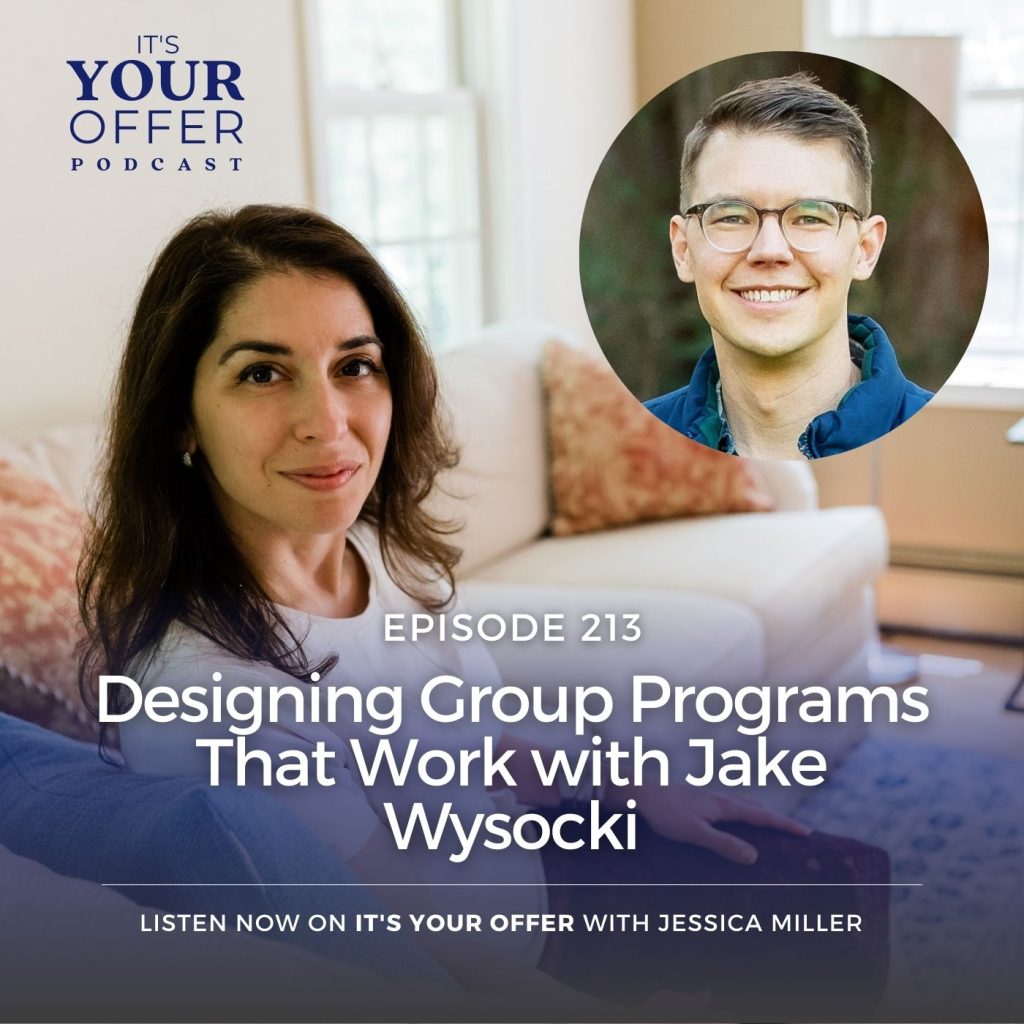
What does it really take to design a group program that creates powerful results without burning you out or overwhelming your clients? In this episode, I sit down with Jake Wysocki of Intention Craft to unpack the intersection of design thinking, human-centered facilitation, and entrepreneurship.
Jake shares how to transform your knowledge into experiences that actually work, while keeping them simple, flexible, and focused on what matters most: your clients’ results.
Ready to design programs that truly deliver? Don’t miss this insightful conversation with Jake where we break down exactly how it’s done. Enjoy!
In this episode, you will learn to:
- Why group programs fail when you try to “teach too much” and how to avoid that mistake.
- The secret to structuring a program that feels customized, even in a group setting.
- How to build your offer around client outcomes and reverse-engineer from the result.
- A simple 10-50-99 framework for designing and iterating your program in real time.
- How to harness tools like AI without losing the irreplaceable human connection that makes programs work
💬 Loved this episode? Let’s keep the conversation going—DM me on Instagram (@jessicadioguardimiller) and tell me your biggest takeaway!
Mentioned in this episode:
Work/Connect with me:

Meet Jake Wysocki
Jake is an experienced workshop designer and facilitator who founded Intention Craft.
By the time he left the corporate world in Jan 2024, he had coached, trained, and facilitated workshops for hundreds of people as a Design Thinking Strategist.
He now uses those skills to help coaches and consultants deliver World-Class group coaching experiences.
On the personal side, he lives in Milwaukee, WI, with his wife and two daughters, ages 4 and 8. He is always down to talk about Bluey, Notion, or overly complicated ways to decide your next movie to watch!
Jessica Miller (00:02.512)
Hello, Jake. Good morning. Welcome to the show.
Jake Wysocki | Intention Craft (00:05.1)
Thanks, Jessica. Excited to be here.
Jessica Miller (00:06.884)
Yeah, I’m so excited to have you here. How’s everything going?
Jake Wysocki | Intention Craft (00:09.772)
Everything’s going really great. It’s been a busy summer, not to get super personal because people aren’t tuning into your personal stuff, but we had a great trip with the family to Hawaii and got to see Kilauea actually actively erupting like 150-to-300-foot fountain. So, we just happened to time it exactly right. And it actually stopped while we were there. So anyway, my life’s great. Love and life. Business is good. I’m excited to be here.
Jessica Miller (00:21.427)
my gosh.
Jessica Miller (00:32.422)
love that. That’s so awesome. my gosh, your kids must have been like over the moon at this. I bet.
Jake Wysocki | Intention Craft (00:36.226)
They thought it was really cool. they wanted to get closer and I’m like, I don’t want to get closer. We were pretty far away. We’re close enough. Yes. Yes.
Jessica Miller (00:40.922)
Right? Yeah, you’re like, this is good. This is good. Let’s look at it from here. That’s awesome. Good for you. I love it. Well, I’m so happy to have you on the show. So happy for everyone to hear about your business and your journey. You have such a cool journey from where you started and your background. Why don’t you tell us a little bit about that? Because I think it’s just a really awesome part of your story.
Jake Wysocki | Intention Craft (01:00.814)
Yeah. So, um, I won’t go all the way back to the beginning, but I do have an engineering degree. I like to start there because it kind of sets the tone. So, I have like a process mindset and engineering mindset, if you will. But then I took kind of a left turn into sales and then we could talk about this if you want this sort of a side note, but I love kind of bragging about this a little bit. My wife and I quit our jobs and we traveled for a year and that was in 2015. And then I came back to the same company, a big fortune 200 company in a product development role, which then led me into.
Like a design role called design thinking. So, I was a design thinking strategist in my final role at this big company, which basically was teaching people at the company how to do design thinking, the methodology of design thinking. And, and I’ll share what that is in a second. And then alongside that, also were facilitators for hire sort of within the company. So, the C-suite or the VPs or whatever would have some big initiative that they want help with a big, like a big workshop. They’re bringing or flying everybody to India. We did that a few times.
And we, designed it, facilitated it and helped them like move their business forward for lack of better word. And, and then, so let me fill in the blanks with design thinking, cause it’s kind of a buzzword, but like a lot of people don’t really know what that means. Design thinking the way I describe it is you take a capital D designer. So, if someone went to school for design and they, they are a designer, they have a certain mindset and a toolkit that they use all the time in their work. That’s like design thinking.
Jessica Miller (02:00.192)
how cool.
Jake Wysocki | Intention Craft (02:27.809)
The practice that I was involved in was exporting that from that world into people who are not capital D designers and often doing less traditional capital D design work. So, think like HR professionals improving HR systems for themselves using a human centric mindset. That’s like the main mindset piece and the, sticky note exercises is kind of the quintessential toolkit, but it’s really structured exercises of any kind. And so really actually loved that work. And for.
Like basically vibe reasons, if you will, like I just kind of felt like I needed to change. I decided to leave and start my own thing. And I can talk about how that happened if you’re interested, but that’s kind of what led me to where I am today, more or less into my entrepreneurial journey. was, beginning of 2024.
Jessica Miller (03:16.402)
That’s amazing. And so, you took all this design thinking expertise. And when you and I first spoke, was like, I have no idea what design thinking is. It has the word design in it. I’m very interested because I’m creative. But I love the intersection. I just felt like where you were going with your company was this intersection of creativity and all of that you learned from that and that engineering piece of helping people practically and tactically implement this in some way in their business.
So, talk about that piece. You took it into your business because you saw what opportunity, like what were people struggling with.
Jake Wysocki | Intention Craft (03:50.189)
Yeah. So, I’ll fill in a few more blanks just to share my journey. My first thought, my first stop in my entrepreneurial journey was to help other people do, what I call stay the unions that my wife and I were doing. It’s basically a workshop that my wife and I do every quarter more or less. And it’s basically zooming out and looking big picture. It’s so easy to be stuck in the now. And my company’s name is intention craft, partly because of that. whole key is how can we be intentional with our life? How can we live our life on purpose instead of just a drifting, if you will.
And I was looking around at my friends and many of my friends, they’re great, by the way, if you’re listening, hi, love you guys. but I’m like, you could just use a little bit more intention, a little bit of what my wife and I do and your life would be that much better. I’m not saying we are doing it right, but the process we follow would be useful for anybody. So, I started there and that was going okay. But along the way, I met somebody who knew my background and they said, Jake, I need your help.
I’m doing an in-person workshop for my coaching clients. I’m freaking out. I don’t know what to do. I feel like I’m over my head. I’m like, yeah, I’ll help you out. So, I just started helping them just, you know, cause we’re friends or whatever and had tons of notes, loved what I was doing. And I saw that there was an opportunity to help people deliver great experiences for their clients. And at the same time, the other piece here that’s kind of intersecting was I was in a few accelerator programs at this point and the programs were great. And that’s where we met in one of these accelerators and it’s great. And.
Jessica Miller (04:47.718)
Hmm
Jake Wysocki | Intention Craft (05:11.394)
Because of my background, I’m like, you know, what if, what if they just did these few things differently? It would make a big difference. And I started seeing opportunity to help people who were trying to do things like I was trying to do, just do it better. So, it’s kind of like a meta, like a meta-awareness that came to came to mind for me. some of the problems are how do we even like structure like a curriculum around my knowledge? Like one of the big things is if you, if you’re trying to grow your business at some point, if you’re doing one-on-one coaching,
Jessica Miller (05:23.739)
Yeah.
Jake Wysocki | Intention Craft (05:39.405)
And you want to keep growing either. You have to charge more. You have to take on more clients or you have to spend more time. And there’s maybe a few other, have to hire people. Right. And a lot of people said, well, I don’t really want to grow in these other ways. I feel nervous about, charging more or whatever. Let me try scaling my business by taking on more clients, but at the same time, do like a group coaching program or an accelerator program or a mastermind. Whatever. These are all different things, but basically kind of the same general concept. And my thought was.
Jessica Miller (05:59.622)
Yeah, uh-huh.
Jessica Miller (06:04.636)
Sure, yeah.
Jake Wysocki | Intention Craft (06:09.524)
It doesn’t take a lot to do a really good job, but most people don’t know how to do. They know how to iterate and adapt on a one-on-one call. It’s a lot easier just to say, Jessica, what, like, here’s my plan for today. Do you have anything different? And you just kind of talk it through and you, you have a structure, but it’s super flexible because it’s one-on-one, but people get a little nervous when it’s like, okay, I have eight people. can’t do that with eight people because one person might have something different than everybody else. They might be sitting there wondering why the heck am I here? Cause I don’t want to talk about that.
Jessica Miller (06:22.49)
Right. Right.
Jake Wysocki | Intention Craft (06:37.666)
What do I do? How do I make, make sense of this? So anyway, it kind of started with, let me help you make sense of your main, like your main flow, your main structure. And then we can turn that into a program. And there’s actually a lot of nuances to that. We actually don’t do a lot upfront. do it one piece at a time as you’re rolling it out, but that’s like a whole another topic. Happy to deep dive if you want.
Jessica Miller (06:47.056)
Yeah. Mm-hmm.
Jessica Miller (06:57.488)
I love that. Yeah, so it was, I mean, I can so relate to this with my own business journey. I think sometimes people underestimate how different it is to take your structure or your IP and put it into different formats that are like one to many versus one to one. And how, to your point, there are some really powerful ways to do that that people don’t even notice, but it’s so impactful.
but you have to know how to do that. Your brain needs to work that way. And most creative people, I don’t know that their brains work like that. Tell me where I’m wrong. What do you think about that?
Jake Wysocki | Intention Craft (07:34.999)
No. So I had this realization when I was talking to some of my who, my now clients and I was on a call with them and I just said, well maybe you could structure it this way. I can’t remember exactly what it was, but it was something like, so what I’m hearing is you’re doing 30 minutes of teaching in one go, and then you’re asking them some questions. What if instead you gave them two minutes of teaching, then had them do something right away and then they understand the material they’re actually learning by doing, and then they’ll have better questions for you.
And you can like, whatever it’s less boring, et cetera. And they’re like, wow, you’re blowing my mind. like, I felt like that was super basic and simple. And that’s the type of thing that, you know, I’ve heard other people say, and I had this moment of awareness, the things that are easy to you or the things that are easy to me. That add a lot of value for people and like below people’s minds are probably the things you should lean into or certainly there’s a ton of value there that you may not even realize. And so.
Jessica Miller (08:23.068)
Right.
Jessica Miller (08:26.546)
And usually we discount it too, Jake. I feel like we’re like, oh yeah, no, everybody knows that. Everybody knows don’t talk for 30 minutes. No, they don’t know that. I mean, they don’t.
Jake Wysocki | Intention Craft (08:31.468)
Yes.
Completely. And this was a complete for this client. This was a complete mindset shift. They’re like, my gosh, like, that’s completely different. And it was, it wasn’t just, it was a small thing for me, but it was a huge thing for them. And what I help my clients with is figuring out what that is for them. I think, I think it’s often referred to as like the curse of knowledge. The things I think are easy, like the basics, the fundamentals, even like the fundamental fundamentals, if you will.
Jessica Miller (08:41.202)
Mm-hmm.
Jessica Miller (08:54.257)
Hmm?
Jake Wysocki | Intention Craft (09:00.57)
are probably where you should focus most of your time with like a cohort, for example, because that probably gets the biggest bang for the buck and it’s probably not obvious for most people or even if it is, I’m not a sports guy. So, this may be incorrect, but I’m pretty sure LeBron James practices free throws all the time still. He’s arguably the best in the world, maybe ever, but he still focuses on the fundamentals. So even the best coaches, clients, whoever you serve.
Jessica Miller (09:03.186)
Hmm.
Jessica Miller (09:11.858)
Mm-hmm. Yeah.
Jessica Miller (09:16.786)
Hmm. Mm-hmm.
Jake Wysocki | Intention Craft (09:26.584)
Can still benefit from going back and focusing on the fundamentals. And often that’s where the biggest gains are. Cause you forget to focus on or iterate from where you started, you know, whatever you started your journey from.
Jessica Miller (09:36.816)
Yeah, this is so, so true and it’s so important. And I think we especially forget about this with the more established entrepreneurs. I see this with my consulting clients all of the time. If someone’s just starting their entrepreneurial journey, we kind of have this preconceived idea that they need help on the basics. Like they may not know, right? And we’re leaning into those things or kind of reminding people about those things when they’re in that place. And even then, like you should remind them a lot. But when people start to get…
even more successful, like a million dollars above, I cannot tell you how many times those basic, simple things, and they’re not even necessarily basic, because I think some of the concepts you’re talking about, they’re not basic, but they are simple and they’re powerful and we forget because we have so many more things to think about or we become an expert in one area and we’re not thinking about the other stuff that somebody else is an expert in. And it is, its mind blowing. It’s just also giving people permission to like,
Just keep it simple, make these two changes and it’s gonna make a huge difference. For your client that was doing like the, you used that example of like teach for 30 minutes or teach for two minutes. So, they were running a group program where they were running something where there was a lot of people and they were structuring, was it a Zoom call that they were doing?
Jake Wysocki | Intention Craft (10:53.708)
Yeah. So, these, most of my clients, not all of them, but most of them have, for example, a group program. It’s eight weeks, 90 minutes a week, one, one 90-minute session each week for eight weeks. That’s probably a better way to say it. And, and yeah, so it’s usually, online with a zoom call and then. Yes. So, to answer your question, yes. Did you want me to go deeper on, on that?
Jessica Miller (11:05.404)
Yeah. Yeah.
Jessica Miller (11:15.11)
Yeah. Yeah. Yeah. Tell us a little bit more about them. The client. Yeah.
Jake Wysocki | Intention Craft (11:18.828)
Yeah. So, for example, this client actually has had an accelerator for 12 weeks and he helps people build community programs. You actually know him, our friend Jordan, which actually really quick side note, he is one of the straws that turned me to this type of business because I saw his testimonial in Dustin’s group are also mutual friend. And I said, he’s helping people kind of in a sort of similar way that I was thinking this is possible. So, he kind of unlocked that. So, it’s kind of funny. It kind of came full circle.
Jessica Miller (11:28.924)
Mm-hmm. Yeah.
Jessica Miller (11:38.8)
Yeah. Yeah.
Jessica Miller (11:46.502)
So good. Yeah, he’s awesome.
Jake Wysocki | Intention Craft (11:48.643)
Yeah. So anyway, he’s helping people build communities and he was getting caught up in a lot of like teaching. know all these things. And he realized through me working with him, I don’t want to do that. I want to help people do it their way using the fundamental principles that I have, but helping guide them rather than this is, this is Jordan telling everybody how to do it the right way. It’s Hey, here’s, here’s a good place to start. Let’s work through some of these, like you said, not basic, but foundational things. Like what is your offer? For example,
Jessica Miller (12:15.132)
Yes. Yes.
Jake Wysocki | Intention Craft (12:17.282)
Like, what do you actually, mean, well, this will resonate with you, of course. Like, what are you actually trying to offer your clients? Because if you don’t have that, in a solid place, doesn’t have to be perfect and it shouldn’t be perfect. There is no perfect, but if you don’t have that in a good enough place, everything else comes harder. And I think of this along with a few other things I can share as like a found, like whether it’s your offer or broadly for programs, what I would say is the, outcomes, like the, the things you’re trying to.
Jessica Miller (12:19.76)
Yeah. Yeah.
Jessica Miller (12:26.47)
Right. Right. Yeah.
Jake Wysocki | Intention Craft (12:46.316)
help your clients with. the promise, if you will, the outcomes that you’re trying to give them, what they have when they’re done with your program that they didn’t have before they started. If you can get that really clear. And again, it can change, but if you get that really clear, it makes designing your program so much easier because now you have a filter in which to decide, should I talk about this or should I talk about this? And so just, just use Jordan for an example. And I’m assuming he won’t mind. This is kind of free PR.
Jessica Miller (13:04.271)
Yes, yeah. And Jake, I want to also say something about this that you do that I don’t even know if you do, but this is like music to my ears. It’s not only knowing that result, it’s starting there. It’s starting with the end. Like, what are you solving for? What is that brand promise? And then how does your program make sure that it hits that target? Most people like design the thing and then like end up somewhere and it’s not necessarily even
Jake Wysocki | Intention Craft (13:14.477)
Yes.
Jake Wysocki | Intention Craft (13:18.478)
Mmm.
Jake Wysocki | Intention Craft (13:28.269)
Yes.
Jessica Miller (13:34.05)
what the result is that they want. So, it’s like reverse engineering is key.
Jake Wysocki | Intention Craft (13:39.695)
Yes. I would, so that resonates with me a ton. One of my foundational books that I ever read was Stephen Covey’s seven habits of highly effective people begin with the end of mind. So that really speaks to me. So that was interesting that you pointed that out. Yep. I love that. Um, so yeah, no, no, no, that’s okay. Please do. I love, I love, uh, when you see something, don’t let it pass cause otherwise we’ll forget. And, and so one of these filters,
Jessica Miller (13:48.262)
Yes. Yes.
You’re doing it. Yeah. So, Jordan, sorry, I didn’t mean to interrupt you. Okay. Yeah. Sure.
Jake Wysocki | Intention Craft (14:05.996)
was I helped Jordan think about this is you’re trying to help them build their first community, for example, or launch their new community kind of pens, but same basic concept. And so, when he was going through some of these more advanced techniques, this kind of ties in what we were talking about. said, is that actually helpful to get their first cohort? They probably don’t need a marketing funnel. They just need to go talk to enough of their people directly. Cause this is a high-ticket sale. So, all you need to teach them for the sales process is really how to fill your first cohort. It’s not build a sustainable system.
It’s focused on this. we cut a ton of content out, but let him go deeper with his clients on actually solving the main problem that they have at the point they’re at. And then you can solve those other problems later. That becomes then a good backend offer, et cetera.
Jessica Miller (14:43.762)
Sure. Yes, which is also like give them an early win. Give them an early win. And when it comes to sales, as you know, there is a whole different like process funnel. How complicated do you want to make this? If you are going to sell to a cold audience, something that’s $50, or you’re going to reach into your existing warm community to sell a high-ticket program or get the people who already buying your thing to come into the circle community, totally different. Yeah.
Jake Wysocki | Intention Craft (14:48.672)
Hmm, yes, yes.
Jake Wysocki | Intention Craft (15:10.594)
Yes, yes.
Jessica Miller (15:12.144)
love and then they get that they check the box they’re thrilled they’re like what else can you teach me that’s so good yeah, I love that awesome yeah so, he was solving for that problem and that probably then opened his eyes to the next step
Jake Wysocki | Intention Craft (15:16.46)
Yes, exactly. Yes.
Jake Wysocki | Intention Craft (15:26.006)
Yeah. So, for, for Jordan, I don’t know how deep you want me to go with this program, but basically, we, we stripped it down to it’s the, the basic pieces and made more room for talking. So, here’s another one of my, design principles for group programs. If you’re going to have a group program, make sure you’re maximizing the benefit of having people together live on a call. So again, this is another thing with don’t give too much content. Now there’s a little bit of nuance here for anybody listening. If you’re starting your first cohort.
Don’t do a lot, unless you have this already, but don’t do a lot of pre-recording. Just do it live, figure out what works first, even if it’s relatively more content that you’re delivering live, that’s okay when you’re learning. But ultimately, I try to find ways to maximize that connection because the power of a group is that it’s not just Jake’s knowledge, it’s not just Jordan’s knowledge, it’s not just Jessica’s knowledge, it’s everybody’s knowledge in the group that can also contribute and collaborate. And.
Another benefit of groups is that you have people in similar starting points. They may not be exactly the same, but they are going on a journey together. And there’s something really powerful about that where you have people you can become friends with. like you and me, we met in an accelerator program. I have many other friends I’ve met in these programs because you’re going through the same thing together at the same time. It creates these bonds that can last and create ripple effects throughout your entire business in ways that I’m like, I don’t even predict, but I’m sure there’ll be people that I met.
Jessica Miller (16:34.834)
Mm-hmm.
Jake Wysocki | Intention Craft (16:49.43)
In my, in my cohort that will like come at some of them became my clients, for example, but there’s going to be even more than just like a client relationship with so many of these people. So anyway, I’m bouncing around a little bit, but there are so many benefits. That we were trying to basically distill it down to maximize the, the collaboration, the live feedback, especially for this was the second cohort. I was helping them with the second one. And, how do we actually figure out what works well, and then we can refine it down the road.
Jessica Miller (16:56.988)
Yeah. Yeah.
Jake Wysocki | Intention Craft (17:18.296)
But how do we get those reps in? How do we get feedback from our clients and really learn from them? And the best way is talk to them live. Don’t do, you could do surveys, but surveys don’t do it. It’s getting feedback live through Q and a, and maybe some questions when you wrap up each session, but.
Jessica Miller (17:31.954)
Yeah, I love that. Okay, so Jordan, and I love we’re using him as an example because I think he’s amazing and he’s got such a great program and he’s had so much success. So, he moved into that part of making that cohort stronger, running it differently, gathering that feedback, kind of building it real time, which I think is so smart. I mean, I’ve done this in launches as well. So many people need to think that they need to do so much of this work beforehand.
I think it’s a really awesome skill to be able to give people a framework that they can flex with. And I say this especially for any live component of anything, whether it’s you’re going to be on a podcast or you’re going to be in front of a live room. Like if it is so rigid that you can’t roll with real life, it is going to fall apart and you’re going to fall apart. And I think people get so nervous about these things, but the more rigid that they get,
Jake Wysocki | Intention Craft (18:19.394)
Yes. Yes.
Jessica Miller (18:25.722)
without understanding the big picture like you’re talking about and just having the tools, the actual worse off they’re gonna be because they’re nervous and it’s now rigid and they’re just gonna fall apart. I think it’s awesome that you’re teaching him, you’re giving him a framework, but it sounds like you’re also teaching people skills on how to navigate through this situation, whatever they’re in with their own community or their own group so that they can get people to a certain result, but also
flex with it and I would say even insert like some of themselves in it. You know what I mean? It’s not like it’s not you’re like here you go Jordan. Here’s how you’re gonna run your call. It’s like actually collaborative.
Jake Wysocki | Intention Craft (18:59.342)
100%.
Jake Wysocki | Intention Craft (19:05.486)
Yes. So, a few things. Um, hold on a quick note. Cause I want to come back to something you said, but I want to get another thing too. Um, so the first thing I want to mention is yes, a hundred percent. Um, if you’re not watching live on the video, I was nodding my head vigorously when you were talking about, don’t do it all at once. This is the biggest, uh, problem I see most people do. I need to have everything ready to go before I even try to sell it. Like I need to know what I’m doing so I know it’ll work.
Jessica Miller (19:12.027)
Okay, yeah.
Jake Wysocki | Intention Craft (19:33.807)
Please, if you’re listening, do not do this. You do not need to do this. This is a terrible idea. It’s possible it may work. Maybe, maybe you’re going to tell me, that worked before. That is an outlier. I promise you that’s an outlier. Even if you know your stuff really, really well, I recommend doing it in a rolling fashion. And I use a framework like internal to my program called 10 50 99. And that loosely corresponds with like percentages done. And so, for a program, the 10 % level is the
Jessica Miller (19:43.729)
Hmm.
Jake Wysocki | Intention Craft (20:01.822)
what I call the identity work. So how do you want your program to feel like the experience for your clients? What kind of, and I have a process to come up with like three main adjectives, like, guided, inspirational and, collaborative or something like that. Right. And we, we hone those down in that axis of filter, the outcomes that we already talked about the content basically acts as a filter. Those are two of the key components and then a broad outline. And that’s just how many sessions, what topic for each session.
Jessica Miller (20:17.297)
Yeah, yeah.
Jake Wysocki | Intention Craft (20:31.278)
And what takeaways are you hoping to have for each session? And that’s it. And there’s like a few details. You probably want to know when it’s going to start and how much you’re going to charge and things like that. But for the program itself, that’s all you need. Don’t build anything else. And then here’s where the 50 and 99 come in. So about two weeks before, and this is, this is how I work with my clients, but even if you’re just doing it yourself, do this also two weeks before your first session, start working on that 50 % plan. Now that 50 % plan is what I call a delivery guide.
Jessica Miller (20:39.292)
Sure. Yeah.
Jake Wysocki | Intention Craft (20:59.384)
But it’s basically a detailed agenda. It’s not delivery materials, which is like slide deck, worksheets. If you’re doing that, a Miro board, like an online whiteboard, if you’re doing any of that stuff, great. Don’t do that yet. Or certainly don’t do very much. Maybe just a bare bone. If you feel like you must, that’s okay. But I don’t even do that. Usually, it’s just a detailed outline that you could more or less deliver like right now, if you had to, even though you don’t have all the supporting things, you can just say, okay, I want you. I’m actually doing this with Jordan.
Jessica Miller (21:15.442)
Mm-hmm. Mm-hmm.
Jake Wysocki | Intention Craft (21:28.854)
for a workshop we’re putting together, but just start with having people write on paper. So, you could do this. Now, usually I take it one step further to the 99 and help build the slides. And these are basic slides. You do not need pretty slides. If that’s your brand, I guess that’s another thing you can do that, but you definitely don’t need polished slides. but you’re doing the slides, the workbooks, the, whatever else you want, the week of your program and also the 50 % for the next week. So, it rolls.
So, you’re developing this because what I found time and time again, that first session, especially for a first cohort, but even if you’ve been doing this for a while, if you do an exercise called hopes and fears and I’ll, I could talk to you briefly about it, but I have it actually in my crash course, which we can share at the end. Uh, I have a video and everything. I’ll walk you through it, but it’s a great exercise to understand what your clients actually need. So, you, you start with this hypothesis basically of here’s what I’m doing with my program that acts as the North star that we are very talked about and.
Jessica Miller (22:12.903)
Yeah, okay.
Jake Wysocki | Intention Craft (22:27.138)
You’ve talked to clients to sell. You’ve probably honed a little bit and the actual clients in your program will probably tell you way different things when you do this exercise. Then you’ve been hearing all along. So, one of my, one of my other clients, Joe McKay, I think you also know Joe, he, he did this and he said, Jake, our whole plan is, is, is needs to be completely changed. I did the hopes and fears and I’m, a little bit nervous because there’s a ton of pressure and everybody’s telling me about their, how this is supposed to change their life and affect their life. And he goes, but now that I’m thinking about it, it’s actually really good.
Jessica Miller (22:39.25)
Yeah.
Jessica Miller (22:46.129)
Right?
Jake Wysocki | Intention Craft (22:57.166)
Because now I know what they actually need help with that I can help them solve in the same, uh, in the same lane that I’m on. just need to shift a bit and we’re going to restructure some of this stuff. was going to talk about LinkedIn next week, but that’s, we don’t need to talk about that. We need to talk about like mindset or whatever. forget exactly what it was at the time. Anyway, I’m getting excited about this stuff. So let me just take a break. I start talking fast. So, I’ll just take a, take a breath.
Jessica Miller (23:13.842)
Mm-hmm.
Jessica Miller (23:18.802)
Welcome to the club. You’re in the right place, Jake.
Jake Wysocki | Intention Craft (23:22.178)
I mean, I love, I listen to podcasts really fast too. So, if you’re like me out there, I apologize. Cause if you’re like me and you listen to things at two X it’s probably like four X right now. So anyway, yes. So anyway, just to wrap this up and then we can, have a collaboration piece we can talk about too. the, the piece I find so fascinating is if you have, and you mentioned this, if you’re not super rigid and you become rigid because you,
Jessica Miller (23:25.414)
Me too. You’re right.
They’re also used to that.
Jake Wysocki | Intention Craft (23:51.437)
You fall into this sunk cost fallacy of I’ve already designed everything. I already have the slides. This is too much to change. If, if you find yourself in the, I’m to do it in a rolling fashion, 10 50 99, like Jake just outlined, you can adapt as you go, just like Joe did and say, okay, now I know what they actually need from me. And I’m still going to teach my stuff, but it’s going to be with a different lens in a different order or in a different.
you know, a different way of thinking, but it’s still the same fundamental things, but now I know actually what they need. And honestly, it’s, less analytical. So, this is where I take off my engineering hat and I put on my like human centered design, design thinking hat. And I use a little bit more of my, empathy and my gut feel for, okay. It feels like we should be talking about this. Let’s just try that. And I’m big on experiments to treat your program like an experiment. If you’re just doing your program once.
Why are you doing it? guess, right? Like, I guess it could be a reason. Maybe you choose not to continue going, but you should assume that you’re going be doing this multiple times. And so, each one is an experiment and that you’re to get better and better at getting it closer and closer to what your clients need right off the bat. So anyway, that was a lot of information. Do you have any?
Jessica Miller (24:58.532)
Yeah, no, I love this. And I want to actually say a side note here to this as well that came into my mind when you were saying this. You know, because you and I have a sales background and we’re also very people focused and we’re relationship focused and we’re intuitive people. I think these things really are so important. And of course, I’m biased saying that because we’re both these types of people. But in my experience, I think it’s really important to honor those things and also
Jake Wysocki | Intention Craft (25:02.349)
Yes.
Jessica Miller (25:29.074)
Trust your instincts, trust the human part of things like a group program or an environment where you have people together. And what I want to say as the side note is, this is the place where I think people need to get really, really careful with things like chat GPT and AI, because people will go into these tools and they will be like, hey, chat GPT, I’m running this program. What should I, tell me what to teach?
Jake Wysocki | Intention Craft (25:47.79)
Mmm.
Jessica Miller (25:58.35)
or tell me what this thing is, give me the stuff. And maybe they’re doing that because they’re not at a place where they have enough experience to do it on their own, or maybe they’re doing it because they’re scared, they’re not sure how to run the program or whatever it is. But we go to these tools for the answers. And then we get something that is a blueprint. And there’s a lot of detail in that. So, it can start to approach this rigid place. And then we…
go out there and we try to just implement that thing. A, because we’re not exactly sure where to go. B, because we might be afraid. And C, because we think that chat GPT has all the answers and they know more than we do because it’s this amalgamation of information out there. And I think this is a place where I think people need to get really careful because it is the opposite of what you’re talking about. It is great, I think, in the beginning to start you off with something that is not a blank piece of paper.
or for you to put your information in there so that it can give it to you in a more structured and concise way, I think that’s great. But I think people need to be really careful about what they know, what they think, and even what their intuition is telling them and what the software is telling them. And then that ability to stay in that lane and be themselves and go into the space and use the people that they are actually.
engaging with or teaching or whatever it is as the actual like truth and If you kind of do both of those things you can dance in a really nice way Because it might bring up some things that you didn’t think of or it might take what you put in there and make it more eloquent but there is no substitute for you being in the space and Engaging with your audience and the way you’re talking about and I think we could get really people can get really
screwed up with this type of thing. Especially creators who think that they’re not like business people or teachers or they haven’t done something like this before, which they’re so lucky to have you to give them that guidance. But I think sometimes people try to shortcut it with the software and it’s not going to work out well. And it’s going to end up being more work, I think, actually saving you time. I’m curious what your thoughts are around that.
Jake Wysocki | Intention Craft (28:15.19)
I have so many thoughts on this. maybe we’ll come back for a part two for like a deep, deep dive, but, brief background on my journey with, with AI. was very, very resistant to it until. I don’t know, four or five months ago, and now I use it for a lot. I don’t use it for opinions. I use it for testing. My opinions are helping me make sense of my own thoughts. I find it a good thought partner.
Jessica Miller (28:16.594)
Okay, in short, are your thoughts?
Jessica Miller (28:24.326)
Mm.
Jake Wysocki | Intention Craft (28:45.096)
or organizing my thoughts, kind like you said. But I don’t trust its opinions because if you’ve noticed, it’s really easy to say, well, what about this? And then it says, you’re absolutely right, that’s a great idea. And I say, okay, well, what about this? you know what, you’re right, that’s even better. And I’m like, but it’s not, it’s not better. It kind of repeats back what you say. So, I don’t trust it for opinions. And I actually write about this again on my crash course where…
Jessica Miller (28:56.71)
Right, right.
Jessica Miller (29:02.128)
Right. Just right. Totally.
Jake Wysocki | Intention Craft (29:09.952)
Your, this is a little bit different, but your clients don’t want your option. Like they don’t want a bunch of options. They want your, your, specific opinion about their problem. That’s why they’re hiring you. They’re not even hiring you for knowledge so much as your opinion, your guidance, your support. That’s the main thing they’re paying for. Yes, exactly. Customized, unique support from you about their problems, not just here’s things I could do. Cause there’s especially with chat GPT and all these things, you can get knowledge everywhere.
Jessica Miller (29:15.761)
Yes.
Jessica Miller (29:24.348)
Yes, synthesized.
Jessica Miller (29:31.09)
Mm-hmm.
Jake Wysocki | Intention Craft (29:37.923)
But you don’t know what the right knowledge is or the right, best thing or the thing that’s most likely to work. That’s why you work with an expert like you, like me, like Jordan, like whoever, right? So that’s one thing. Now I will say, and we don’t need to go deep on this, but I have been experimenting with AI to enhance human connection. Cause my whole thing is how do we, the whole point of group program and then broadly with my background of human centered design, I am really big, even though I’m an engineer, I’m really big on.
Jessica Miller (29:38.002)
That’s right.
Jessica Miller (29:44.907)
Mm-hmm. Yeah, I love that.
Jake Wysocki | Intention Craft (30:04.682)
human connection. And I think that’s like the secret sauce with, with what business is going to be, especially in the age of AI. So, I asked myself, well, how can AI help that? And I tested this, with the state of the unions that my wife and I were doing that I kind of dangled before, a few weeks ago. So, we had our anniversary a few weeks ago as of this recording. And I’ve been toying with this idea and I said, let’s try it. And so, we do, if I can go just briefly on this exercise, I think it’s really interesting.
It’s called the wheel of life is what it’s commonly called. And if you’re not familiar, it’s basically take your life and split it into eight categories or whatever. You have a love, you have family, you have relationships, you have health, you have wealth, you have business, know, whatever things like that fun. There’s different ways to break it up. That’s not the point. The point is that you have different categories. And ultimately what we do is we basically do our own and then we talk about where we’re at each individually and then come together as partners in our marriage and figure out what’s working well. What do we want to change? And this is like big picture thinking.
And what I realized was we spend a lot of time thinking out loud in the moment. Like we do the, we do the rating, the gut field intuition, which is useful. And then we kind of talk through it and it’s a little bit messy. And that’s like, there’s some benefits to that. And I said, what if AI could help us make sense of our own thoughts beforehand and then help us communicate our thoughts more clearly by, cause that’s one thing it is good at is kind of condensing things and making it concise and more accurate to what you’re trying to say. And we long story short, we tried this.
And we both loved it. was fun to like talk through it. Just kind of, I built a basically custom GPT. I use Claude, but for lack of better word, a custom GPT to walk us through and ask us questions and act as like a challenger and say, well, what about this? What about that? And it just helped us think through it. And then we came together for our actual session and it was a deeper conversation because we got to get to the meat of the conversation really fast and communicate. I don’t want to go deep on this, but I love this concept of like these companies like deep mind that are trying to basically read your mind.
I have these thoughts in my head that I’m trying to communicate to you right now and all the listeners. And I’m using this really clunky, even if I have a big vocabulary, this really clunky medium called speech to put words to these really complex and nuanced thoughts. And so, the goal is how do I replicate my thoughts into your head, into the listener’s head? And that’s a challenge. Now AI doesn’t solve that whole thing, but it helps get one step closer by taking a bunch of thoughts and condensing it down to something that you’re like, that is what I’m trying to say. And it’s closer. It’s more concise. So anyway,
Jake Wysocki | Intention Craft (32:31.854)
I am skeptical about AI replacing like coaches and all these things. There’s some things that can do some things that can’t do, but I am exploring and I’d love to hear from anybody out there who hears this and is like, that’s interesting. Tell me more. Cause I’m trying to figure out how these fits in with like group programs and stuff. have some hypotheses right now, but, um, I do think there’s an opportunity, but there’s also a risk, like you said, and it’s not just fear of, don’t replace me. If it can do what I can do great. It probably should, but today it can’t, it can’t know intuitively.
Jessica Miller (32:51.826)
Mm-hmm.
Jessica Miller (32:57.838)
Mm. Right.
Jake Wysocki | Intention Craft (33:01.774)
Or even like, uh, structurally, like the opinions that I have that I’ve seen work that I can tell will work for you because we have a connection and I understand deeply what you’re trying to do. Like that’s really hard, if not impossible to replicate with AI today. So, all the way back to your original point. agree. And it’s interesting. How can this impact our businesses and support it rather than replace? Anyway.
Jessica Miller (33:19.472)
Yeah, yeah. And I think the beauty of human connection is like, there’s a limit to what you can communicate through words. As humans, right, there’s a whole realm of wordlessness that we don’t have words for, and people are communicating and connecting and learning through that. It will never be that emotional tool. So, if you can harness it for the things it’s good at, and then you put the human element in it and you find that beautiful place of how to do that.
Jake Wysocki | Intention Craft (33:28.589)
Yes.
Jessica Miller (33:46.256)
well, just like you’re talking about, and you have the structure to support it like you’re talking about, that is a killer combination. Yeah, please.
Jake Wysocki | Intention Craft (33:53.251)
Yes. Can I, can I plus one that really quick? Because the, maybe one day it can read body language and blah, blah. We’re not there yet. Who knows, you know, but even if it can, I don’t think it solves this problem, but that’s where it becomes really powerful is if you can like have an easy way to communicate your core concept and that’s knowing yourself first. And so, it’s kind of my broader hypothesis, which I didn’t touch on, which is the biggest problem with communications. We don’t actually know what we think ourself.
Jessica Miller (34:00.42)
Right, maybe. Right.
Jake Wysocki | Intention Craft (34:21.526)
And so that’s built into all of my exercises, give people time to think for themselves first, even if it’s all live in a session, not with AI, that’s besides the point. But how can we understand what our opinions are first and then share it and communicate it. But it’s that extra layer. It’s someone sharing something deeply important to them when you’re talking about hopes and fears and someone’s cracking up, like their voice is cracking because they’re sharing how their wife is sick in the hospital and they’re really scared that if this doesn’t work, then they’re gonna be on the street or whatever.
Jessica Miller (34:24.688)
Hmm
Jessica Miller (34:28.306)
Sure, yeah.
Jake Wysocki | Intention Craft (34:47.904)
And they’re getting really emotional about that communicates so much more than just a story being told. And this is made up and I’m getting a little emotional just thinking about it, but that helps you design a more empathetic. That’s what we need. There’s like a, an X factor or something that is very difficult to replicate with technology or impossible. That is just the human connection. And there’s probably a word for that. I’m sure there’s smarter people than me talking about this already, but this is what I love to help people foster in their group programs.
Jessica Miller (34:55.076)
Emotional.
Jake Wysocki | Intention Craft (35:16.598)
or whatever group experience you’re doing because that’s like, that’s what life is probably over overly simplistic to say that’s what life’s about. But it’s such a big part of life is connecting with other people.
Jessica Miller (35:24.22)
Yeah. Yeah. It is. It is. And you you’ve heard this a lot on my podcast. You know this from us knowing each other, but energy is everything. It is everything. And it is communicating to other people. is sharing your hopes and dreams when you’re not saying it. People are picking it up and it’s the stuff that really matters. It generates the emotion and people are emotional people and they make choices about what they buy, who they work with, what their business looks like, all of those things.
Jake Wysocki | Intention Craft (35:33.708)
Hmm. Yes.
Jessica Miller (35:53.778)
through that emotion. I think we also like humans are relatable. We relate to other people through that emotional sink. We’re like, oh, you’re my people. I get it. You talk with your hands too. You can talk quickly. Right. It’s that stuff that I really think to your point, I don’t think technology is there yet, but sometimes like people will become friends with chat. GPT. see this, right? I mean, right. So, there’s
Jake Wysocki | Intention Craft (36:03.18)
Yes.
Yes.
Jake Wysocki | Intention Craft (36:18.088)
Mmm, true.
Jessica Miller (36:20.464)
There is also this interesting place of like the realness and the not realness and like what is going on there. So, I think it’s an important thing to keep in mind and the fact that it’s kind of a core component of your model I think is awesome. And knowing just going back to Jordan and you know this example like knowing him, he is an intuitive emotional person. And that is something that for him it’s like we want to infuse him into his program as well.
So, he went through this work with you and his cohort, and then now on the other side, what is happening with him? Like, how is that looking different for him now that he’s worked with you and you guys have been creating this collaboratively?
Jake Wysocki | Intention Craft (37:02.028)
Yeah. So, I, the first, the first immediate thing came to mind is I get so excited working with someone like a Jordan, because not only is he a client and a good client of mine, he’s a good friend of mine now. And it’s like, we work together in like a deeper way because he’s like my people doesn’t mean you have to be exactly like Jordan to get along with me or whatever. But just as an example, it’s a pleasure to work with him. And then that actually then translates into the program.
Jessica Miller (37:09.17)
You
Jessica Miller (37:13.424)
Yeah.
Jessica Miller (37:18.716)
Sure, exactly. Right.
Jake Wysocki | Intention Craft (37:27.724)
because we have such a, strong relationship now because we’ve worked through all these things and we’ve gone deep on his program and what he’s trying to do. He’s in the middle of, not overhauling per se, but changing a number of things in his, in his offer stack. And because I’ve been able to understand it and talk to him about it, he gets like, he texted me with ideas. He’s brimming with ideas. He’s like, what if we did this? What if we did that? I don’t know if I’m actually answering your question, but the change in him that I’ve seen is like,
I mean, not that he wasn’t excited before, but he has all these ideas and these new projects we’re working on. He’s just so excited about it where, like when we first hooked up, he, was like a drag almost. He’s like, I’m doing this thing. I think this is a quote, an actual quote. Um, I think he said at one point, and this shouldn’t diminish any of the work he was doing with his clients, but he said, I feel like I’m just winging it. And I’m like stressed out because I’m doing these things like last minute.
Jessica Miller (38:07.472)
Yeah.
Jessica Miller (38:17.734)
Sure, of course not. Yeah, yeah.
Yeah, I’m insecure. Yeah.
Jake Wysocki | Intention Craft (38:24.462)
Cause I’m overwhelmed and I need help. And now he can show up and deliver and really focus on his clients. So anyway, I think I came back to finally answering your question. I think that’s a better way to answer it, which is went from feeling overwhelmed, stressed, not sure about what he’s doing or why it would work or just like, will this work? And now having someone, this is one of the things he told me is I want someone to come and tell me what to do. Not that you’re telling me how to exactly do it or how to be Jordan, but here’s some things you should do.
Jessica Miller (38:48.336)
Yeah.
Jake Wysocki | Intention Craft (38:53.666)
And that’ll give me, part of it’s just confidence. Like you could probably deliver things so many different ways. And part of what I’m doing is just giving you a thing to do, like a choice to do that I know will work for many people. And then you go try it and then maybe you make some tweaks to customize it yourself. But because you know that, hey, this works and it makes sense. And the way he explained, I see it now. Now he can just deliver with confidence, with excitement and really focus in on his clients, which is my goal is to help you connect with your clients better. So.
Jessica Miller (38:55.94)
Yes,
Jessica Miller (39:13.009)
Yes.
Jessica Miller (39:22.02)
Yeah. Yeah. mean, what I’ve heard on the street, because we run in similar circles, is exactly what you said. I think it’s multipronged what I’ve seen from your work. And I think you’re feeling it. And what you just mentioned that Jordan said is also speaking to that, which is there’s two pieces to this. Like one is people are showing up different. They’re, different because they are now clear and they are confident with, with that comes confidence and there you’re able to be more visible.
People hide when they feel like they’re not doing things right. And he was doing a great job, but it’s what was internally going on for him that was making the difference, right? Plus, when you get to that place, it unlocks all this creativity. And a lot of the people that you’re working with are creative entrepreneurs. A lot of people listening to this podcast are creative entrepreneurs. So, when we constrain the pieces that we need to, we allow expansion in the other areas and that creativity is one of them. The other really important piece that I think is also huge is that
Jake Wysocki | Intention Craft (40:15.287)
Hmm. Yes.
Jessica Miller (40:19.716)
is that last part that you said, which is when you work with an expert who designs these things for a living and they have the experience to do that, then the structure is on point. And when you can see and you know that that is going to work, like it’s actually created appropriately, then you get to be who you are. You get to show up with the confidence because you believe in it and you can focus on the thing that you want, which is the people in the room. And you know that the
foundation and the structure is going to take care of itself. Like I know for me, I’m not an engineer, but I should have been one. Like when I can see where the bouncing ball is going, like, yeah, this piece is going to click into this piece and this piece, and we’re going to end up here. And this is where I want. And now I can hold this middle part loosely and just show up as who I am. I mean, it’s just like so good. I like get 10 years of my life back, you know? And that allows people to have the peace in their business that they want.
Jake Wysocki | Intention Craft (40:55.091)
Yeah.
Jake Wysocki | Intention Craft (41:07.47)
Yes.
Jake Wysocki | Intention Craft (41:12.29)
Yes.
Jessica Miller (41:18.022)
The other thing that you didn’t talk about, but I think you are gonna talk about this, is it’s measurable. Like now you have this framework, we ran this thing, it looked like this. What worked, what didn’t work? What do we wanna do differently next time? Which brings people to this place like you were talking about with Jordan, where he gets to iterate now with you. And there’s gonna be other spin-offs of that, or there’s gonna be other pieces of his group program that are gonna just get better because he’s now iterating on that. But he’s not like burning the thing to the ground and starting over.
Jake Wysocki | Intention Craft (41:22.764)
Hmm. Yes.
Jake Wysocki | Intention Craft (41:47.427)
Yes.
Jessica Miller (41:47.514)
you know, from a place of like, I’m not really sure if this is gonna work and it’s a lot of work and I just want to go hide and watch Netflix.
Jake Wysocki | Intention Craft (41:54.863)
Yes. I want to, I want to share a, my favorite, like pro tip for understanding how to iterate. And I learned this specific phrase that I, that I love from whatever I was doing before from John Meese, also mutual friends. And, it’s you end every session with what was your biggest takeaway. And I love this phrase because one, it creates a ritual and I’m a big fan of have a, have a beginning ritual, which is often wins. Like what are your wins for the week?
Jessica Miller (41:56.914)
you
Jessica Miller (42:01.552)
Yeah. Okay.
Jake Wysocki | Intention Craft (42:23.862)
And you end with, is your biggest takeaway? And it creates a ritual. Number one, number two, gives, your clients, your participants, that moment to think. And actually, start like building that, that cycle of, am getting value from this. It’s good for them. It’s good for you. It’s good for their view of you and what you’re doing, but it’s actually getting them to think about what did they learn so that they can actually start, like synthesizing it in their subconscious or whatever you want to call it. And then the final thing is it gives you feedback. So, I mentioned way back at the beginning.
The 10%, one of the things you have are where the takeaways that you want with each topic that you’re doing. And now these will change a little bit, especially your first one, like we talked about, but you should be maintaining this and you should be designing it around what takeaways are you hoping to hear? It’s not a problem if you don’t hear those takeaways at the end, but you should hopefully hear a few of them. And if you don’t, then you can either tweak what you think your takeaway should be with better ones that you’ve heard. There might be things like we talked about, like, that thing that like offhand comment, I wasn’t even planning to say that just came up. That’s your biggest takeaway. Wow. I’m like.
floored right now, but maybe I should lean into that and make that officially part of next cohorts run or whatever. Or you can say, I’m like way off and I need to find a way to bring this. Like, I feel like the stuff we’re hearing is useful. Maybe I’ll make that supplementary, but I’m still not hitting it the way I want to hit it. And then you understand I need to iterate and try to get closer to that goal. So, I love, what is your favorite takeaway at the end of every call? And then at the very, very end, you don’t do that for the call, the very final, session, you do it for the whole program, by the way.
Jessica Miller (43:25.564)
Right.
Jessica Miller (43:29.33)
Absolutely.
Jake Wysocki | Intention Craft (43:51.371)
And I also learned this from John. I’ll give credit where credits do those become great testimonials also are like those natural things that they took away that then you can use for, especially for the whole program could be the individuals, but the whole program in particular can be then used to help fill your next cohort, et cetera. So, there’s a pro tip.
Jessica Miller (44:06.736)
Yeah, I love that. Yeah, that’s so good. And I agree with you. Sometimes, and this goes back to what you and I were talking about even before the episode of like, these things that you do or you say or you think are not necessarily important because you know them and you’ve heard them a million times. And then that’s the thing that people latch onto. And I think you said it as well. Sometimes it’s because it’s a really important piece and you’re glad they’re getting it. The other times it’s just because that’s what they needed to hear right now. And that is equally valuable.
Jake Wysocki | Intention Craft (44:35.34)
Hmm. Yes.
Jessica Miller (44:36.754)
and that can help you meet people where they’re at in that moment because Whatever is top of mind for people is their problem that in that space, right? So, you want to you don’t want to veer totally off course, but you also want to help them where they’re at So it’s really cool for the work that you’re doing. Are you mostly working with clients one-on-one right now? Or you have you found that that’s best or you’re doing it in group or what are your thoughts?
Jake Wysocki | Intention Craft (44:52.398)
Success.
Jake Wysocki | Intention Craft (45:01.304)
Yeah. So ironically, even though I teach people to do group programs, I’m not yet doing my own. I will do that eventually, or I plan to, that’s my plan. But right now, I’m really enjoying doing that one-on-one work so that I can really understand my clients better working with them one-on-one. for example, you don’t have to do this, but if you were going to come to me and say, I’m new at business. I want to do group coaching program. My first question would be, well, how are you going to fill that program? Which is again, John’s domain, but my question would be.
Jessica Miller (45:05.84)
Yeah, sure.
Jake Wysocki | Intention Craft (45:27.5)
Why are you starting with the group program? Do you think you can actually fill it? Do you know people? Do you have an audience? Do you whatever? Because I think there’s so much value to working one-on-one first, even if you want to do group program to figure out what you like, what your frameworks are, what works for people or just understanding the people that are coming to you. And then it becomes easier for me also, if you work with me to pull some of that stuff out, cause you’ve been there, but also, it’s just practically easier. anyway, that’s the path I’m following. Number one.
And number two, a lot of what I’m doing right now is almost like agency work. So, I started with this idea of doing coaching. and it turned out, especially with like Jordan, I’m actually doing a lot of the delivery material work. Like I’ll create his slides or at least the basics of his slides. And in fact, I think he just uses most of my slides still. They’re not pretty, but they work. And that’s kind of his whole thing too, which is why we get along well. like it’s more important what the content is, not that it looks. Fair. Totally fair.
Jessica Miller (46:04.594)
Hmm.
Jessica Miller (46:11.985)
Yeah.
Yep.
You’d have to make my slides pretty, Jake, I’m just saying.
Jake Wysocki | Intention Craft (46:22.066)
and I will say just a brief diversion on that. It’s the, I’m not saying you’re not doing this. I’m sure you’re not doing this, but it’s easy to hide behind beautiful design and have like nothing there. So that’s why my emphasis is always make sure the content, the, the like transformation you’re actually delivering is solid and then you can put design on it, you know, whatever you can follow your own path. But what was I talking about? I lost my thread.
Jessica Miller (46:31.388)
For sure. That’s right, no substance.
Jessica Miller (46:42.79)
You can print it up. Yeah.
Jessica Miller (46:48.486)
You were talking about how you were working one-on-one with people and you had started on that journey. No worries.
Jake Wysocki | Intention Craft (46:52.606)
yes. Thank you. So anyway, I’m working one-on-one and what I, know, basically my model is, you want to be at the, is a little bit different application, but like the 10%, which would be coaching the 50%, which would be helping you with, which is kind of my, my bread and butter, like the middle, I’ll help you do. Like the complicated, like here’s what you’re actually delivering, but then you build the delivery materials. But like, like I’m with Jordan, I can also do the delivery materials. So, some of those, the coaching would work in group the other two.
Less so unless I’m coaching it through the 50 % or something like that, but I like doing the work right now. It’s also helping me really understand what it takes for these clients to actually deliver. So yeah.
Jessica Miller (47:24.29)
Right. Yeah. Yeah.
Jessica Miller (47:31.908)
Yeah, yeah. mean, I think, you know, where I stand on, you know, starting out with one on one, I think it’s the most powerful. And I think there’s so many legs to the offer that you have where you could, you know, have affiliates for the tools that you have found that people use on the back end of programs for work for groups that they’re structured based on your framework. You’re like, OK, here’s the blah, blah, blah. So, like the fact that you’re building them right now.
and working in that sort of agency model allows you to find those opportunities of other things that could be either passive income for you as an offer, or you could say, hey, if I just worked with all the Jordans of the world, these are all the tools we would use on the backend, and here’s all the templates, and plug and play, and you could be an agency or consulting for just like that niche even. So, there’s so much opportunity.
Jake Wysocki | Intention Craft (48:23.02)
Yeah. And then one more thing on that, another benefit to that. And I recommend this for everybody is it’s useful to have at least a few one-on-one clients or an opportunity to go really deep because things change, technologies change the way people, you know, want communities change, you know, tastes change, all these things change. And so, if you’re actually doing some of the work and plugged in directly with that work, it’s a lot easier to stay abreast to whatever like.
Jessica Miller (48:36.738)
my gosh,
Jake Wysocki | Intention Craft (48:50.338)
the things you need to be helping your clients with are because you’re actually helping do them. And so, I find a ton of value because otherwise like the things that I think are easy, aren’t necessarily easy for other people. And I may be completely missing, like, that thing I told you to do is like this huge project for you where for me, it’s like an hour, just working session, because I know how to do it really easily. And I didn’t realize that you needed a bunch of help with that. So, working one-on-one with people is a good way to, to really stay in touch with what it takes and what people need.
Jessica Miller (49:19.546)
Yeah, I think that’s so true. And even for people who may not have the skills to be the creator of those types of outcomes, you could just review people’s work, keep them on a sort of a schedule, have that accountability. Like if this is the next thing that they need to do and you’re meeting with them every week per se, you have a very clear schedule of what they need to be doing and you could look at it. And then if they get stuck in between those calls, you kind of get a sense, like, it’s Monday, how’s it going?
Jake Wysocki | Intention Craft (49:32.674)
Yes.
Jessica Miller (49:48.176)
if it’s crickets or they don’t know how to do something and you know how to do it in five minutes, you could always jump in to support them. But depending on how people kind of net out with that type of their skills, they could still do a really great job doing that, I think.
Jake Wysocki | Intention Craft (50:03.608)
Totally. And that goes back to that human centered approach. Like that is my bit. Like if I had to pick one sort of, philosophy, if you will, is human centered, like all the, like, I love technology, I love processes, but none of that matters if you’re not actually helping the humans on the other end of your program, on the other end of your screen, on the other end of your, your agency work, on the other end of whatever it’s always thinking about the humans on the other end of it. And that goes everywhere. So yeah.
Jessica Miller (50:08.049)
Yeah.
Jessica Miller (50:14.194)
Mmm.
Jessica Miller (50:20.849)
Yeah.
Jessica Miller (50:26.652)
Mm-hmm. Yeah.
Jake Wysocki | Intention Craft (50:31.212)
I could go on and on about that, but I’ll just leave that piece there.
Jessica Miller (50:32.806)
Yeah. Yeah. I love this so much, Jake. And yes, we could talk about this forever. Maybe there’s going to have to be an episode number two, but this is awesome. I love this. I love the framework. I love that you’re so passionate about your clients. I mean, that is one thing, as I said earlier, like energy is everything. I think people really feel it. And being that I know some of your clients, I, of course, I know that they feel it. But this has been so helpful. And I think it’s so great to have something so structured that people can hear and
Jake Wysocki | Intention Craft (50:40.162)
Definitely.
Jessica Miller (51:01.884)
They can go and think about their own business in this way and I know that they’re going to. So, if people want to find you, where can they connect with you out there in the interwebs or wherever?
Jake Wysocki | Intention Craft (51:10.892)
Yeah. so probably the best place. And I’ve talked about my crash course a little bit. So, if you go to course.intentioncraft.com, you can get my crash course. And I’ve put my goal for this, by the way, is to put as much of my knowledge in there as possible. Cause even if you want to hire me, knowing the stuff is only part of the battle. It’s the specific opinionated help that we’ve talked about. So, I’m, my approach is dump as much of my knowledge in there as possible. I’ve got a lot of really good feedback. So definitely check that out. And then if you want to get in touch with me.
Just reply to any of those. goes straight to me. You can also find me on LinkedIn. I’m not super active on socials, but you can find me that way too.
Jessica Miller (51:47.186)
Okay, so course.intentioncraft.com. Awesome. Awesome. This was awesome, Jake. Thank you so much for coming on.
Jake Wysocki | Intention Craft (51:49.922)
Yeah. And I’m sure there’ll be a link in the notes somewhere. Yeah.
Jessica Miller (51:58.428)
For everyone else, I will see you guys all. Yeah, thanks for being here. And for everyone, we’ll see you next week. Have a great week.
Jake Wysocki | Intention Craft (51:59.478)
Absolutely. Thanks for having me. This was great.