Subscribe


What you’ll learn in this episode:
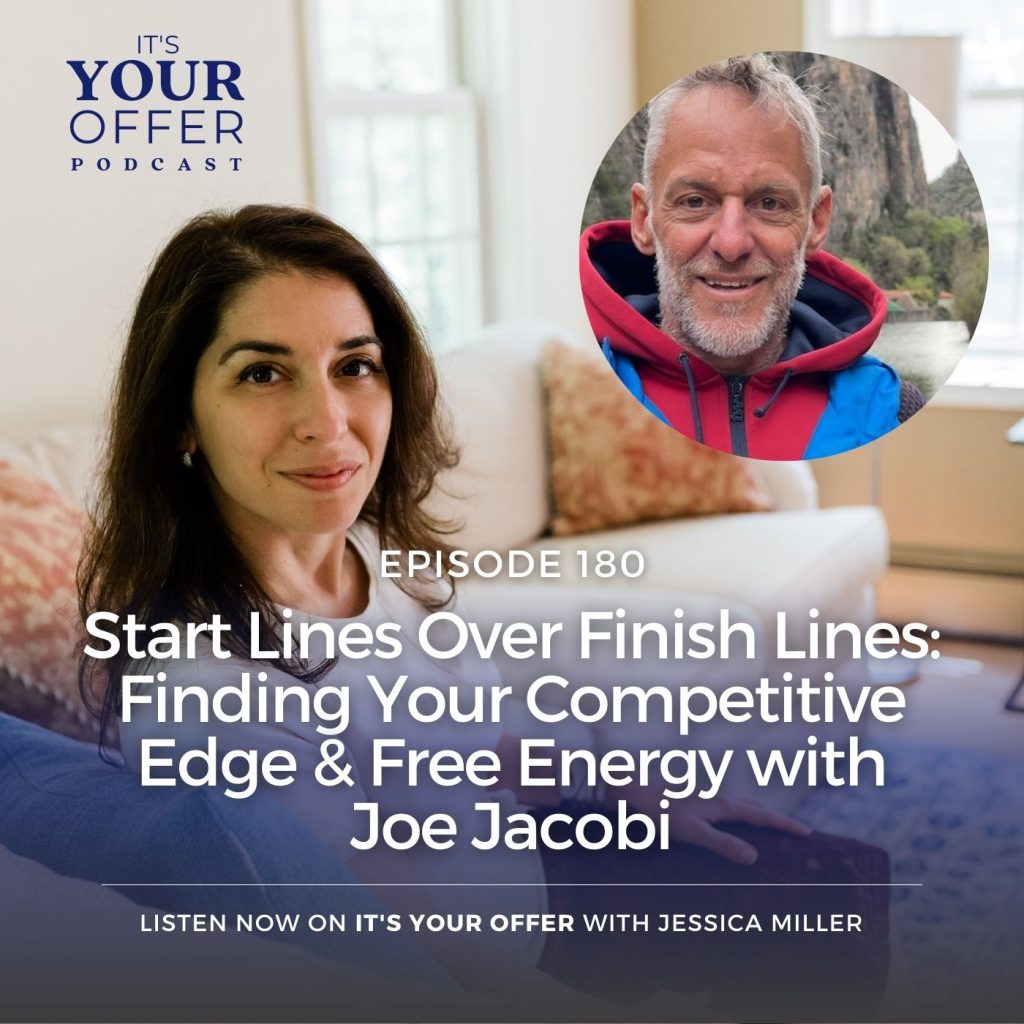
What if the real secret to success isn’t just crossing the finish line—but how you show up at the start? I sat down with Olympic gold medalist, performance coach, and leadership expert Joe Jacobi to break down the mindset shifts that drive sustained success, fulfillment, and flow. In this episode, Joe shares powerful insights from his journey—from training with elite competitors in Washington, D.C., to reinventing his performance approach in North Carolina, to now living and coaching in Spain.
This episode is packed with wisdom for high-achieving entrepreneurs who want to leverage free energy, optimize performance, and find deeper meaning in their work and life. One of my favorite concepts is when Joe talks about why your competitive edge is a dial, not a switch, and how understanding this can help you stay in flow without burning out. Whether you’re a business owner, leader, or just someone navigating life’s transitions, you’ll walk away with new ways to align your purpose, sharpen your focus, and ride the waves of life with intention.
🎧 Listen now and start riding your next wave of success with intention and clarity!
In this episode, you will learn to:
- How to crank up your competitive edge when it serves you, and dialing it down when it doesn’t
- Which waves (our metaphor for opportunities) are the right to catch and why letting waves pass you by are just as important as the ones you ride.
- How to think beyond the finish line and instead build a sustainable, purpose-driven life and business.
Mentioned in this episode:
Connect with Joe Jacobi Online
Work/Connect with me:

About Joe Jacobi
Joe Jacobi is an Olympic Gold Medalist, Performance Coach, Transition Expert, and Author who collaborates with high performance leaders to unlock their Why, achieve impacting Wins, and ride better Life Waves in pursuit of Midlife Peak Performance.
Joe practices and refines these core principles and strategies in his own life and pursuits at his Pyrenees mountains home beside the 1992 Olympic Canoeing venue in La Seu d’Urgell in the Spanish state of Catalunya – the same canoeing venue where he and his canoeing partner, Scott Strausbaugh, won America’s first-ever Olympic Gold Medal in the sport of Whitewater Canoe Slalom at the 1992 Olympic Games.
He writes and publishes Thinking In Waves, short and focused weekly essays that transfer his experiences and lessons from surfing off-shore ocean waves on a surfski kayak to an innovative model for clear thinking, better choices, and increased value alignment.
Additional Highlights
- A 19-year career as an elite athlete with USA Canoe/Kayak that included 10 National Championship titles, two Olympic Games appearances and an Olympic Gold Medal
- Served as the Chief Executive Officer of USA Canoe/Kayak, the national governing body for competitive paddlesports under the umbrella of the U.S. Olympic and Paralympic Committee
- Joined NBC Olympics as Canoe/Kayak Color Commentator at the 2008 Olympic Games in Beijing, China
- Paddled 113 miles with friends on a non-stop sea kayak expedition from Havana, Cuba to Key West, Florida
- Paddled rivers in 25 countries
- Ran 11 marathons
Jessica Miller
00:01 – 00:06
Welcome to the podcast, everyone. Joe, I am so happy to be here with you. Welcome.
Joe Jacobi
00:07 – 00:10
Jessica, I’ve been looking forward to this for a long time. Thank you for having me.
Jessica Miller
00:10 – 00:19
Yeah, me too. What a good start to the new year. This is going to be an awesome conversation. For our listeners, tell us a little bit about you, who you are.
Joe Jacobi
00:21 – 01:03
Oh, this is always the hard, you start with the hardest question, right? Of course. So, I think one of the unique things about me is that I’m an Olympic gold medalist in the sport of whitewater canoeing. I am a performance coach and an author. One of the interesting things about my life is, as you and I are speaking right now, just outside my window here, I am sitting about 50 meters from the 1992 Olympic canoeing venue where my canoe partner, Scott Strausbaugh, and I won the Olympic Games. Oh my God, America’s first ever gold medal in the sport of whitewater canoeing.
Joe Jacobi
01:03 – 01:36
So I’m living in the Spanish state of Catalonia in La Seu d’Urgell. It was a quality of life move that I made 7 years ago, and I absolutely love it. I love living here. My brain is like on and learning all the time, especially another language, and another culture. And yeah, it really adds a beautiful perspective to my pursuit of my work, health and wellness, creativity, and of course, my relationships.
Jessica Miller
01:37 – 01:41
Yeah. Did you pick that spot-on purpose or did you happen to just land there?
Joe Jacobi
01:41 – 02:31
Well, what it was is, so if I go back to the 1992 Olympics, actually a year before the 92 Olympics in 1991, to this sport of whitewater canoe slalom. Whitewater canoeing is really popular in the United States, but competition is not so much. But competition here in Europe, this is like the hub for whitewater canoe slalom competition. So, in 1991, we had like an Olympic test event here called the pre-Olympic race. So, it was a chance for the athletes to get to see the canoeing venue for the first time. And it was a chance for the organizers to test out the venue, make sure the scoreboard worked, put spectators into the venue, all those kinds of things.
Joe Jacobi
02:31 – 03:07
It was a test for everyone. And like, don’t feel bad for me, like living out of a duffel bag in my late teenage years and early twenties and being in Europe for 1, 2 months at a time was amazing. It was absolutely fabulous. And the relationships and paddling rivers and all these mountainous areas around Europe was great. But I remember arriving here in La Seu a year before the Olympics and I just had this epiphany. I like, I sat up on my hotel room bed the first day I arrived here. I had never been here before.
Joe Jacobi
03:07 – 03:41
And I’m kind of looking and thinking about my competitors from Europe. And, you know, they can go home so easily and get a home-cooked meal by mom. They get their clothes washed, sleep in their own bed. And I just remember thinking to myself, Jessica, like, I got to figure out how, you know, not to feel like a visitor in the Olympic Village a year from now. Like, I got to feel like figure out how I can create a sense of belonging and connection to La Seu. And it was really interesting. That was like a huge click moment.
Joe Jacobi
03:41 – 04:23
That was a real unlock moment for me. Because after that, instead of having all these transactional moments like oh we need to get dinner or we need to go buy food or we need to go exchange money. Now all these people around you are like your neighbors and you’re really trying to build a sense of connection and community with these people and it was amazing was that a year later, I remember walking to the Olympic venue on the day of the Olympic race. We hadn’t done anything yet. We were just walking to the venue, but feeling like a huge, huge check had already been put through the box, you know, in having that sense of connection to La Seu.
Joe Jacobi
04:23 – 04:55
So I tell you that story because you know you asked about you know picking La Seu as a place to live. I didn’t come here to sort of reinvent or relive my life as an Olympic gold medalist. I have no interest in doing that. I love my relationship with the sport. You can, for those that are watching this, you can see paddles over my shoulder, the same paddles that Maria and I used to paddle in the river and in the sea. So, I’m active in the sport, but I came here to do something very new and different with my life.
Joe Jacobi
04:55 – 05:11
But it just so happens that I think the attraction was, you know, I figured something out about a connection to the Catalan spirit and the Catalan culture when I was in my 20s that I was curious to keep, you know, to pursue in further, you know, in my 50s.
Jessica Miller
05:11 – 05:49
Yeah, that’s so interesting. So, two things really jump out to me from most, one from a business perspective, but also one from a personal perspective. The business perspective is just the power of being connected to something, like how that compels you, how that is part of the experience, how that really impacts the outcomes. You are a different person a year later because of those connections and because of your identity of being part of something. And I think that is a big piece of the puzzle for many people, especially teams within companies, owners connected to their work and to their clients.
Jessica Miller
05:49 – 05:59
It’s a really important piece. And it’s interesting to see how it played out for you through a sport, you know, in a sports arena too, right? It’s there too.
Joe Jacobi
06:00 – 06:59
It’s amazing. I’ve Over the years, I’ve gotten to know almost every Olympic medalist that we’ve had in whitewater canoeing since the 1992 Olympics. And I really have yet to meet one or to visit with one where winning the gold medal or winning any Olympic medal was going to just make them happy. Almost every one of them, there was a process. There was an attachment to learning and growing and figuring things out. And really, it was like more of a journey of learning, growth, exploration, fulfillment. And winning a medal was like a byproduct of that. And so, often what I see and the reason that I like, I have this little mantra that I talk about called start lines over finish lines, where, and I know it sounds like counterintuitive, but you’re, every day it’s like you have to cross the start line.
Joe Jacobi
06:59 – 07:22
And like the only finish line that I really know I’m going to cross in life is at the very end. And it’s like, I’ll know it when I cross it. Every other finish line I’ve ever crossed, figurative finish line I’ve ever crossed, including the Olympic Games, it was really just the start line to something else. Like it was just another start line to growing and sort of continuing the journey in another way.
Jessica Miller
07:23 – 07:45
Yeah. That makes me think of this idea of recommitment. Because it is a journey and part of the piece that you can control is getting on the start line. Like recommitting every day to that moving forward. Like you don’t know where you’ll end per se, but part of the battle is just getting started, getting there, committing to doing it.
Joe Jacobi
07:47 – 07:52
I love talking about the start area. I mean, in fact, my house looks right at the start line.
Jessica Miller
07:54 – 07:56
All these synchronicities, Joe, not by accident.
Joe Jacobi
07:57 – 08:28
It is funny. It is funny. I never knew I was going to end up in this house. And I didn’t have a house that looks at the finish line of the course, it just looks at the start line. But I’ve always said that, so in our sport of whitewater canoeing, Jessica, it’s a lot like skiing where It’s just like one competitor on the course at a time. So, when you’re in the start area, which is this calm, flat-water area, it’s just you and the timer and the start house and the beeps of the clock counting down.
Joe Jacobi
08:29 – 09:00
And I always called the start line and the start area like the most sacred space I’ve ever like experienced on earth. At that point, you know, there’s no bravado or macho talk that’s going to do anything for you. It’s like you are just stripped down to just the essence of who you are. And what I noticed for me at that point was, you know, you have about a minute because the boat in front of you left a minute before you and the next boat is going to leave a minute after you. So, you have about 60 seconds in that space.
Joe Jacobi
09:01 – 09:39
And I at least one of those really overwhelming emotions that I felt in that space was gratitude. You know, it’s like, you know, because you’re just so raw and stripped down, like there’s nothing else. Like, you know, you’re just very aware, like all these people, and everything that kind of got you to this point. And so, it’s very peaceful, it’s very serene. And you know, you cross the start line at the Olympic games. And at that time, you had about a five second sprint on flat water before you entered the Rapids. And I always said, it always felt like such a relief to cross the start line.
Joe Jacobi
09:39 – 10:07
It just felt like now we’re getting down to the real thing. Now we’re getting down to the real work. Now, things built up and the, you know, the ambience of the run over the next two minutes, it changed. You’re doing better and better and better. You can sort of feel like this is working out pretty well. This is getting better and better and better. But in the beginning, you’re just freaking relieved to be started finally, like the anticipation is over and you just get to start.
Jessica Miller
10:07 – 10:15
Yeah, I love that. I love it. I have to ask you what got you into the sport? Like, is it something you always wanted to do? How did you end up doing this?
Joe Jacobi
10:16 – 11:03
It’s funny, there’s a little bit is sort of embedded in Malcolm Gladwell’s book Outliers. So, part of it was, I know you’re a Northeastern person, I was born and raised in the Washington DC area. And I know, especially today, like a lot of people, you know, wouldn’t say being born and raised in the DC area is like good for anything. But funny enough for the sport of whitewater canoeing, it was amazing because at the time in sort of, I can explain this in sort of Malcolm Gladwell terminology. When I was sort of, when I was 10, 11, 12 years old, so this would have been like the early 1980s, the United States was dominating the sport of whitewater canoe slalom, even though it was super popular in Europe.
Joe Jacobi
11:03 – 11:46
And we had all these world champions, the legendary coach of the sport, and they were all based in the Washington, D.C. area training on the Potomac River because the sport was not an Olympic sport at that time. There was no money, there was no funding in the sports. So, the athletes needed either jobs or universities to be able to do the activity. So, most of America’s best whitewater is like in Appalachia or Colorado and these very rural areas. But the Potomac River has world-class whitewater just like right where DC, Maryland, and Virginia come together. So, you have great jobs and you have great schools in an area where you can train really well.
Joe Jacobi
11:46 – 12:22
And my sort of fortuitous circumstance in life, at least as Gladwell would say, I was born and raised in the DC area and about 10 years after all these legends, so I was like 10, 11 years old and these guys were in their early 20s. And the paranoid legendary coach of the sport, Bill Endicott, was like, we need to find some new talent. Even though we didn’t, we were doing just fine. But their talent recruiting efforts yielded me, which is not like I was a good athlete. Like I was a short, overweight kid, but I loved being around those guys.
Joe Jacobi
12:22 – 12:56
And my mom loved me being around these guys as well. And I just kept showing up every day. And so that’s really my story of like how I got involved in the sport. And funny thing was, I went to my first US team workout when I was 12 years old, just as a chance for the US team coach to see us and get to know us and see who we were. And 10 years later, everyone at that workout, all those world champions and the legendary coach of the sport, they were either my 92 Olympic teammates or they had retired and become one of my coaches.
Joe Jacobi
12:57 – 13:16
So it was like this very tight-knit community of high performance that has always kind of been inside my DNA. And I’m 55 now, and I still lean into a lot of those principles that we learned on the Potomac River, you know, when I was, you know, 10, 11, 12, 13, 14 years old.
Jessica Miller
13:16 – 13:46
Yeah, it’s amazing how that stuff sticks with you, isn’t it? I mean, that was the other, that was the personal thing that jumped out to me when you were talking about where you were living is there are these connections we have to people in places, I think in those formative years. I know for me even going back to the town that I went to college in because it was such an important part of my life. Going back there, it feels like home. It felt like home then. There’s something so ingrained that there’s a pull to that and it’s kind of interesting.
Jessica Miller
13:47 – 14:23
But I love this story because it sounds to me, tell me if I’m wrong, that there was this combination of energy, like I really enjoy this, I enjoy these people, like I’m fortuitously in this space, I’m leaning into this energy, your mom saw it, there’s something like intangible happening there. And then I’m guessing that, you know, it’s not an easy plight becoming an Olympic athlete. So, there’s a part of that commitment and determination married with the fact that you love it and you’re in the right space that carries you forward to success. What are your thoughts on that?
Joe Jacobi
14:23 – 14:59
What I can tell you, it’s spot on. I think there were really two really big attributes that stood out to me about the training group in DC. And by the way, there is another story is sort of a punchline to it. I ended up leaving that area during the Olympic campaign to with my canoeing partner to go to Western North Carolina and start a brand-new training center in Western North Carolina. But I’ll tell you something that was really important about the group in the Washington DC area on the Potomac River. Number one was that the group was intensely competitive.
Joe Jacobi
15:00 – 15:44
Like we, every workout we did was under the watch. It was just super competitive. During the first five years of my career on the US Whitewater team, we finished a lot of World Cup races where my canoe partner and I would just look at each other and say, that World Cup we just did, it was nothing compared to a normal workout on the Potomac River that we were doing with our training partners. So, number one, we had a super high level of competition. And number two, the group there was like, they really promoted with each other and encouraged innovation with the equipment that we were using, the training techniques that we were using.
Joe Jacobi
15:44 – 15:58
You know, when you think about it, canoeing is like this very inherently individual sport. It’s not like football, like where if you don’t show up, there’s not going to be a coach like yelling at you, Jacoby, where were you? Why weren’t you at practice?
Jessica Miller
15:58 – 15:58
To
Joe Jacobi
15:58 – 15:59
It’s never going to happen.
Jessica Miller
15:59 – 15:59
You show
Joe Jacobi
15:59 – 16:34
You show up because you want to be there. But if you do, you will get this amazing encouragement. So, I think that sense of innovation and sense of competition was super, super important in kind of my upbringing on the Potomac River. But it did also my canoe partner, Scott, who was not from the DC area. We had a lot of people who came from outside of the DC area to be there because of all the champions that were there. Some found it very hard to be in that environment. For some, it was more psychological. For my canoe partner, it was just physical.
Joe Jacobi
16:34 – 17:12
He was a really small, petite human being. He was one of the best technicians in our sport, but he was really, really small. He was like a small guy and the workouts were just brutal on his body. So that is when we decided to leave the DC area and go down to Western North Carolina and kind of reinvent everything from the bottom up. And we rebuilt a training center on the Nantahala River in Western North Carolina, which had like very, very different ideas and rules and sort of settings than what was happening on the Potomac River in Washington.
Jessica Miller
17:13 – 17:42
It’s so fascinating. I mean, I could go down this whole wormhole of like, you’ve taken this offer, you’ve taken this thing and you optimize it and you made it better or you made it more tailored to create the results that you wanted somewhere else. It’s so fascinating. But I think the thing that I wanted to like just sort of press on is this idea that when you look at people who have succeeded, someone like you who’s won a gold medal, we have this idea that you like came out of the womb as a gold medal winner.
Jessica Miller
17:43 – 18:24
And I think people think of this in business too. You look at, you know, whatever, Steve Jobs and all these people, and you’re like, they were born this way. You know, this, they just, this is who they are. And hearing you talk about who you were and your skill level and what you chose to do and the environments that you created that made that possible, the connections that you made to make that possible. And then this really, this competitive edge, which I think all entrepreneurs have, like we wanna win, we wanna do great things. It’s not maybe our number one priority, but there’s this desire to put something out there and have an impact and be good at it.
Jessica Miller
18:24 – 18:49
And the evolution of those things and how you went from, like you said, being this kid who was a little overweight and short, and it wasn’t his dream to win a gold medal to someone whose identity is that, right? And identity is as an athlete. And now you’re helping other people perform at these high levels. So, tell me a little bit about that transition for you.
Joe Jacobi
18:49 – 19:32
Well, I’d love to actually dig into one thing you said that I think is so insightful and I think is worthy of a little more exploration and that is the competitive edge and really how we sort of work and refine our competitive edge. I’m redoing my website right now. And sort of the banner for that is, discover your why, achieve impacting wins, and ride spectacular life waves. And so that middle one about achieve impacting wins, that middle step is all about your competitive edge. Now, the reason I wanna sort of go a little deeper on this is that I hear you about wanting to win.
Joe Jacobi
19:32 – 20:09
I get that. I have sort of been on two almost nearly what I would call unhealthy sides of the competitive edge. And by the way, it’s never one thing. It really is a scale. We can move. We can go back and forth on the scale. But, you know, five years ago, you know, when I met Inga Stasielanitti, my co-founder at Elevating Leadership Institute, and she’s an Olympian and javelin. And when you talk with Inga, which, by the way, would probably be a great conversation for you sometime. She is so competitive and at the time I met Inga, I was like anti-competitive.
Joe Jacobi
20:10 – 20:18
I’m like, don’t even talk to me. I’m so not there. And Inga’s like, I don’t believe it. I refuse to believe like she-
Jessica Miller
20:18 – 20:20
This cannot be possible.
Joe Jacobi
20:20 – 21:04
But I was like this person that was like, no, no, I’m like, I don’t carry any technology when I run, which I still don’t do. But yeah, I had really checked out a competition. And by the way, this is not a good thing. This is not like, I found this to be unhealthy. I think on the flip side of it, like you can be so obsessed with winning. Like that’s not so good either. And I’ve been there too. And, you know, my collaborations with Inga have been really helpful in me sort of rediscovering, you know, what it means to be successful, what it means to win in midlife, you know, and working through, you know, significant midlife transitions, especially around 50 years old.
Joe Jacobi
21:04 – 21:38
And I’ve given this like a lot of thought. And I think, you know, what happens is we just tend to check out of our competitive edge, you know, whether, but the biggest thing I would say, Jessica, it’s not a switch that gets turned off. It’s a dial that gets moved up and down. And I think when we, I love this analogy of like, convert your switches to dials. Yeah. Dials are just black and white. And I don’t think we live in a black and white world. I think we live in a world with a lot of gray area.
Joe Jacobi
21:38 – 22:09
And I think the competitive edge ought to be turned up in certain situations. And we ought to be able to have to summon the awareness to turn it down in certain situations as well. And so, like I’m so glad that you brought that up and I think it is, it’s actually one of the real kind of foundational points of my, you know, the coaching work I do. I’m not looking for a certain kind of competitive edge. I’m just looking for your relationship to it and then kind of checking in. I’m like, are you good with this?
Joe Jacobi
22:09 – 22:33
Like, you know, is this something that we ought to be, you know, kind of bringing more into the awareness and reflecting on it a little bit more a few times a day and seeing when I’m getting riled up too much, more than I’d like. Other times we need to be brought up more than I am. It’s all, we can work with it. It’s just, you know, we don’t really, we think of it as a switch more than a dial.
Jessica Miller
22:33 – 22:44
Yeah, I love that. Tell me a little bit more about your coaching and that part of it, especially. Like, how are you working with people? What exactly are you focusing in on helping them with?
Joe Jacobi
22:44 – 23:29
So my coaching is fun, you know, is basically happening through two ways. I have the
Joe Jacobi performance coaching. This is the one-to-one coaching. And with that, a lot of what I’m doing is I’m taking the art of surfing waves, and I’m positioning that as a point of deep reflection and meaningful life transition. And there, I often think about, you know, working with like a 10-year-into-the-future version of yourself, that 10-year version of yourself that is like already fully engaged, is flourishing and focused. And you know, the person you are today, you know, that person is just waiting for the person you are today to begin.
Joe Jacobi
23:30 – 24:15
And so I love working with like, what does it mean to really get to cross that gap and to start thinking about, you know, in a healthy, patient, steady way. And the clients I work with there do tend to be people, not, they’re working with midlife transitions, but I initially thought I would be attracting a lot of people that were sort of like me, sort of around 50. I have a lot of 30-somethings. And what’s so interesting about the 30-somethings and the early 40s is that it’s not so much like they see themselves like at the midway point, but what they do see is they see the midway point and there are things that they don’t want to experience at the midway point.
Joe Jacobi
24:15 – 24:57
And so, you know, that and that could be sort of how their relationships are tracking, how their career is tracking, how their health and wellness is tracking, how their relationships are tracking. And I love that because it means that the younger people are like more aware of this stuff than I was when I was their age. Totally. And that is the ideal way to do it. My favorite story about this is that I have a client who had some success in sport in high school. And then during high school, things went south. And he just never really figured that out and really made a piece with it until we started working with it in a coaching collaboration.
Joe Jacobi
24:57 – 25:08
And his relationship to sport, and it’s so funny because he ended up choosing to work in the sports industry, which is, you know, I don’t think a coincidence.
Jessica Miller
25:08 – 25:08
Sure.
Joe Jacobi
25:09 – 25:43
But, yeah, he just had this very clear vision. He’s like, if I don’t figure this out at 34, he goes, my life at 50 is going to be a real mess. And like, this is the kind of guy like, I mean, if I mean, if, if like, if I had a daughter like that age, like, I would absolutely like he’s the kind of person like, I want to introduce him to you. And, and he’s like that, like, he’s a really, really good, good person. And so, yeah, I think I love seeing that awareness with the younger people.
Joe Jacobi
25:43 – 26:28
So the other side of it is the Elevating Leadership Institute that I’m doing with INGA. That is a high-performance leadership coaching community and there our coaching is very much anchored in principles of high-performance sport, winning principles of high-performance sport and cutting-edge leadership strategies to help people grow their capacity, achieve sustainable success, and really create impact across multiple life dimensions. And so that has been a great experience as well. And, you know, there is there are two really different kinds of coaching. I love the one-to-one coaching that I’m doing. I do some we do some one-to-one coaching and elevating as well.
Joe Jacobi
26:28 – 27:01
But the real premise of it is a high-performance leadership coaching community. We are coaching, we’re leading, but the other members of the community aren’t coaching, but the other members of the communities are accountable for being a part of this environment that really encourages growth and development and fulfillment and the same kind of things that we were talking about in sport that ultimately results end up becoming a byproduct of how you’re learning and how you’re growing.
Jessica Miller
27:01 – 27:47
Yeah, it’s so fascinating. You know, I love this idea. When I started my coaching business, what I started to understand about people building their businesses was its multifaceted, right? It’s not, you’re not one thing. There’s not one anchor. There are certain things depending on your situation and who you are, that if you optimize those things, because maybe that’s your edge, or maybe you’re naturally drawn to it or whatever it is, and it’s connected to an outcome that you want in a certain way, if you start to pull those levers, right? You will do better. But there’s something so fascinating about putting people together in that way and looking and seeing like, okay, where are these opportunities?
Jessica Miller
27:47 – 28:04
Like it’s very individualized, and at the same time, there’s probably some core things that you see. Everyone who wants to move to this outcome has to do these things. So, tell us a little bit about what you’re seeing, because there’s the individual and then there’s the threads, right, the trends that you see with people.
Joe Jacobi
28:04 – 28:48
Well, I think one of the biggest things we see, so at Elevating, we actually, it’s kind of two gateways that we have into Elevating. One is through the coaching gate, coming to our coaching community. And it’s easy to do as like to just, you know, to sort of do our monthly program, which includes like Q&As and a guest speaker. And, you know, we also, I’ll come back to the coaching gateway, we also have these standalone programs we do. Our anchor program is a self-leadership sprint, which is, I think, how I kind of really wanted to answer your question is this idea, of course, we have all kinds of leaders that want to make impact and want to, you know, have these really high performing teams.
Joe Jacobi
28:49 – 29:31
But we do an intensive, a five-week intensive with two sessions a week that are about leading yourself. And we did that in the autumn. It was an amazing, amazing experience. And we’re going to repeat this over and over again. And all these people, they stay in our monthly community. And of course, it’s on us to develop more programming that will work for them as well. But what we learned through that group, through that self-leadership sprint, that one of the biggest parts of feedback that we got was we structured and we really put a lot of context and a lot of constraints around this.
Joe Jacobi
29:31 – 30:10
But we do these, one of the sessions is we do these triads where the people go off in groups of three, and they are talking with each other around a very specific element of leading self. So, they’re not coaching each other but they are listening to each other. They are kind of raising that environment. And, you know, we would be on these group calls, we’d send them into the breakout rooms, they come back 30 minutes later, and you know how it goes, the energy is just, goes from here to here. And so, they came out of that and they said, look, as part of the monthly group coaching program, the ongoing one, we would really like to have more connection with each other.
Joe Jacobi
30:10 – 30:51
So we’re doing these kind of structured one-to-one pairings every month. If people opt in, we’ll pair two people together to have a very structured conversation around a specific topic. And yeah, that was just us listening to like what people really wanted out of that, you know, out of the out of that high performance leadership coaching community, the ongoing program. So yeah, that’s, it’s been really fun. And, you know, I think doing this with Inga, you know, I know she and I are, she’s one of my closest friends, but we’re really different from each other. She was an Olympian and javelin for Lithuania.
Joe Jacobi
30:52 – 31:34
And she’s a high-profile athlete there. She also coaches Olympic athletes today there. Not like technical coaching, but more the mental skills. In the last Olympics, she had four Olympians from Lithuania, two rowers, a javelin thrower, and a triple jumper. And so, Because of Inga’s prominence, even though a lot of her coaching practice is outside of Lithuania, inside of our group, we get a lot of Lithuanians, which is so great. We have a very internationally diverse group. In our self-leadership sprint that we did in the fall, we had about half the people from Europe, mostly from Lithuania, and about half the people from the US.
Joe Jacobi
31:34 – 31:35
It was great.
Jessica Miller
31:35 – 31:36
That’s so awesome.
Joe Jacobi
31:36 – 31:38
It was a beautiful experience, yeah.
Jessica Miller
31:38 – 32:14
Yeah. You know what’s interesting, too, about that focus on the individual, but yet you’re pairing them in community in some way, even though they’re small communities, is that I find that when people engage, even if I’m engaging with you and it’s really self-focused on my leadership, it increases my relationship to you tenfold by being in that space. I learned so much from being in it from you and the work we’re doing, but then my trust level for you, my understanding of you, it skyrockets and all that energy that you’re talking about, it just like buoys everything.
Jessica Miller
32:15 – 32:46
And I think people, they are emotional beings. We make decisions in life, in business, to buy things, to sell, all that, it’s emotional. It’s an energetic exchange, right? So, there is something that, it’s like the secret sauce. And when you can create it, and I used to think that this was just this random byproduct of the work that I did with my clients, even especially in groups. But then you start to realize you are attracting and you are putting energy out, and there are people out there who are going to pick that up. Your right clients are finding you.
Jessica Miller
32:46 – 32:59
They’re finding your business. And then all of a sudden, you’re surrounded by all these awesome people doing awesome things together, helping each other, growing individually and together through your programs, and it’s not an accident.
Joe Jacobi
33:00 – 33:38
So I love this. You’ve been very kind and you know a few months ago you signed up for my Thinking in Waves. I write this weekly essay that is based off my experience surfing offshore ocean waves and a specially made kayak called the Surf Ski Kayak. And so, this isn’t shore break waves. These are out in the middle of the ocean going with the wind. And there is this wave surfing progression that we use like a system, like steps for catching a wave. And I just took that progression and I modified it for what I call surfing life waves, which is what you’re talking about.
Joe Jacobi
33:38 – 34:14
The exact step that you’re talking about and really getting in touch with your own energy and doing that, I think at the essence of that is, so there are these five steps. The third step is called wave selection. And at the root of wave selection is this idea like, yeah, we get it. Every wave looks freaking amazing. We all get, all the waves look good. But my surf ski coach, this big Bulgarian guy named Boyan who has his outfit down in Southern Spain. And since you and I last talked, I’ve gone down to paddle with him.
Joe Jacobi
34:14 – 34:43
And I try to go down there once or twice a year. Just a phenomenal coach. And so, I take all these ideas and I just apply them to life. But what he says about wave selection is that our best surfing will never be defined on the waves we catch. They’ll be defined by the waves we let pass us by, like the ones we choose not to surf. And I think what you’re also saying about when you get good at leaning into your energy and putting your energy out in the world, you’re not for everyone.
Jessica Miller
34:43 – 34:43
That’s right.
Joe Jacobi
34:43 – 35:00
You’re not for every wave. In fact, like once you start loving the fact that like all these waves, beautiful waves, are passing you by and you’re not going to surf them, oh my gosh, you see the really beautiful waves that were meant for you.
Jessica Miller
35:00 – 35:00
That’s right.
Joe Jacobi
35:00 – 35:31
And that’s the free energy from the wave that like I am just fascinated with trying to acquire and apply to life. That’s the leverage that I want to gain in my life, whether it’s in my work, it’s in my relationships, whether it’s my health and wellness, my creativity, that’s the leverage I’m looking for. Where’s the free energy out there that I can acquire and what’s the best way to do that? And so, what you just said really aligns with that third step of the progression, wave selection. What are the waves that you’re willing to not surf?
Joe Jacobi
35:31 – 35:33
What are the waves you’re willing to let pass us by?
Jessica Miller
35:33 – 35:48
Yeah. I think success is in saying no. I think it is in the subtraction. We spend a lot of time trying to do all the things, every wave. And the truth is you don’t need them and they’re not going to get you closer to the result you want.
Joe Jacobi
35:49 – 36:04
I think now we really want to get philosophical and really holistic about things. We can apply this to happiness in life, our relationships. We have everything we need inside of us.
Jessica Miller
36:04 – 36:04
And
Joe Jacobi
36:04 – 36:41
And it’s never going to be a function of adding something. It’s almost always going to be a function of subtracting something that we instilled inside of us or someone else instilled inside of us. It’s a function of unlearning, untraining, reducing, eliminating, it’s always this, and then you clear, and you’re like, oh, it was always there inside of me. And so, I think that’s true about the success in the work, but I think it’s even true about how we see ourselves enjoying this experience that we have here, this life experience.
Jessica Miller
36:41 – 37:20
Yeah. I think so much of that is also caught up in identity. And so, I would tell my clients a lot, you know, success is in the unbecoming. Like we have this idea of who we are in this present moment. But like you were saying, I love that analogy of your future self, because I always tell people like, you are that person. You’re just that person at time point, you know, January 23rd at 945, like, but you are that, there’s this line that you’re on, and you’re that person now. So how do you strip away this identity and dial up these things that are going to help propel you forward basically.
Joe Jacobi
37:21 – 38:02
Two, it’s a great, I love the question and two things that I would say about identity. Number one is that an identity is a noun, right? It’s a thing. It’s like, you know, we, it’s a person, place or thing. One thing that we can do is we can shift every noun into a verb, make it a verb. What is the action that that person does? And that to me sort of removes some of the identity pressure of having to be someone. Secondly, on a more holistic level, is that I actually, I meditate on this every day of removing myself from the identities altogether.
Joe Jacobi
38:03 – 38:41
Like there has to be some space for, I am not this. I am not a coach. I am not an Olympic gold medalist. I’m not Maria’s boyfriend. I’m not Sayo’s father. Like I remove myself. Like there’s, it’s like the old saying in the meditation, who is the thinker thinking about the identities, you know? And when you sort of go back to that and there’s just nothing there, that’s actually where I find it most easy to sort of strip away, excuse me, the programming, you know, all the things that either I’ve instilled or were instilled in me that I need to sort of keep working out inside of me.
Joe Jacobi
38:41 – 39:13
And so I really enjoy this idea that if I just strip it down to just this, like I’m a drop of water, that’s it. One day I’m gonna fall back into the sea and that’s going to be perfectly OK. I think feeling that helps me work with it. And then I can go back. I have no problem with working with those identities and those identities contributing to this life experience that I want to have. I don’t need to have it, but I would like to have it. And I think that’s a really big difference as well.
Joe Jacobi
39:13 – 39:37
I think the easier, softer step is just turning more nouns into verbs. You know, it’s like, instead of like, I want to be an Olympic gold medalist, what does an Olympic gold medalist do? Right. Just go out and do actions, you know, without identifying with what it’s going to be like to be an Olympic gold medalist. That doesn’t matter. Yeah. What’s really interesting is to go and actually just perform the actions.
Jessica Miller
39:37 – 40:20
You do the things, yeah. You know, and I think it goes back to your dial, you know, analogy earlier, which is in different situations or contexts or different fields of your life, you’re going to dial different things up right there you’re going to be this person in this activity, you’re different as a boyfriend than you are as a Olympic athlete or you as a friend as you are as a father, it’s you get to be all those things And I think the more fluid that we can be in borrowing from those identities dialing them up Dialing them down is especially important but getting really intentional about what we’re doing Connected to how we want to feel and the results we want in our life, in our business, in our relationships, all of it.
Jessica Miller
40:20 – 40:32
It’s the same behavior. And I think the stronger we get with releasing some of this stuff, choosing the things, being intentional with what we’re doing, the more we get what we want and really have the impact that we want to have?
Joe Jacobi
40:33 – 41:28
I think the more clear that we are with ourselves, and by the way, it is not easy work. It takes time. It’s an experiment. It’s always ongoing because we’re humans. We’re always changing. We’re always evolving. But the better we get at sort of figuring this out for ourselves and sort of where we are, we get better than it also kind of signaling and communicating to others that are important to us how we want to evolve within those structures as well, whether it’s with a family or a significant other or a partner at work. And by doing that, I think it also really opens up, especially in a one-to-one relationship, how you really play a role in helping that person develop as well.
Joe Jacobi
41:28 – 41:56
So like in the relationship context, I sort of love that element of you, me, us. It’s really hard to focus on all three at once, but it’s really good to kind of keep circling around that and saying, how are you? How am I? How are we? Once you actually check in, you always realize, oh, I haven’t checked in on this in a while. But yeah, like I think that exercise is really helpful as a starting point, but it always starts with knowing ourselves.
Jessica Miller
41:56 – 42:33
Yeah. I also think you really do emit a different vibe when you are, when your heart is in the right place and you are sort of caring about the outcomes or the experience, whether it’s with yourself, with other people, people can pick it up. They know that you’re vibing at that level. It’s hard to explain, but you can feel it, right? People are open and they are not judgmental and they are invested. There’s a presence there to that relationship. And I think that really is the undercurrent that people don’t necessarily notice. They notice it, but it’s not at the top of their mind.
Joe Jacobi
42:33 – 43:24
Yeah. It is interesting when the people who really pick up on it and have sort of been through some of those transitions themselves. And by the way, this is not any judgment on whether you have or have not been through those transitions yet. These midlife transitions that I like to think about and read about and study, they’re so fascinating. Some people get to their end of the lives and they’re just like, no, I really don’t really want to confront my ego. I really don’t want to do that. No judgment. There’s nothing wrong with that. But when you’ve gone through that and you’ve made amends and a piece and reworked what happened when you’re 50 and you’re reworking what happened over the past 30 years, which is not always easy to do.
Joe Jacobi
43:24 – 43:59
The other people who’ve been through that, is like no one can walk that path for you, but gosh, there sure is a lot of beautiful conversation and empathy, you know, for people that have done that before. You know, after winning the Olympics, Jessica, you know, I made a lot of sort of snap judgments about who I thought I needed to be, what kind of relationships I need to have, what I need to be correct about. Yeah. You know, you just, 30 years goes by really quickly and you just never really check in with those things again.
Joe Jacobi
43:59 – 44:37
And you’re like, oh, this is not good. You know, it is like 30 years later, not quite, but almost 30 years later. And you’re like, this is not a good, healthy place. And it wasn’t like a bad decision you made when you were 22. It’s just you never revisited it. You never came back to it. So, we always have that chance to do that. We will always have that chance. But then again, that’s why I’m so encouraged where I see so many people having conversations with people in their mid-thirties, late thirties, early forties, they’re really having a vision of what they don’t want to confront at that time.
Joe Jacobi
44:37 – 45:05
And they’re willing to start that process now. And it’s like, oh my gosh, isn’t this what human, you know, the human evolution is all about? This is exactly what you want to see is more people in their 30s thinking about this now so that by the way, when they get to 50, they get to have a whole new set of problems that people like me aren’t thinking about right now. That’s how evolution works. That’s how we improve as a species.
Jessica Miller
45:06 – 45:46
Yeah, I love that. Yeah, so I’m curious if you, many people listening to this podcast, it’s so relevant to their life, it’s relevant to their business. We’re always evolving, we’re always, I think inherently people are looking to do better. They want to do better. They want to, like I said, have a bigger impact. I just think, especially as entrepreneurs, we’re naturally in that place of innovation and changing and moving forward. What is one piece of advice based on your own personal experience, the work that you do in your business with helping people around performance? What would you say to them if they were to ask you for some advice around this?
Joe Jacobi
45:46 – 46:19
So when I think about my main, we did spend a lot of time talking about the competitive edge today, which I love. Yeah. I think it’s always good to revisit your why, you know, I think it’s just to be really clear about that your purpose, you know, kind of that, not just mission, but really your values and, you know, your purpose of why this matters. I think it, there’s no doubt the kind of people that we’re talking about, it’s not even a question of whether they’re going to be successful. My question is, is whether they’re going to be happy when they reach that success.
Joe Jacobi
46:20 – 46:49
And so I think that’s where purpose is really helpful. So, one thing is, is that I would think a lot about that. And then I sort of do have a second answer to your question as well, which is sort of, you know, I talk about this idea of surfing, you know, spectacular life waves, which is really all about the lever, you know, leveraging free energy and the acquisition of free energy. What is the, what is that other force that’s really gonna help you out and propel you to where you want to go. It’s not frivolous.
Joe Jacobi
46:49 – 47:27
It’s not luck. It’s a model. And what I would say is about that is that what happened, it’s a funny story. And I think people will get a kick out of this. The first time I met Boyan, our surf ski coach, he had a whiteboard. We were doing a whiteboard session before we went to the water and he starts writing out these steps to surfing a wave. And I’m like, Boyan, this is terrible. Like, I’m like, we just want to be like, dude, let’s surf the wave. Like you’re taking away all the creative, fun expression.
Joe Jacobi
47:28 – 48:05
The artistic part. And Boyan said, dude, I’m not trying to take away anything. I’m trying to just give you a little bit of structure so that when things go wrong, an artist knows how to course correct. The artist knows how to get back on track more efficiently, more quickly. And that is when I sort of realized, okay, I think inside of us, I believe there’s an inner artist and an inner scientist. I think that we all tend to lean towards one more than the other. And I think being open to the one that you don’t lean to or towards as much.
Joe Jacobi
48:06 – 48:57
And so what thinking in waves and these steps of the wave surfing progression have taught me is that they’ve engaged my inner science just a lot more because I am a total artist and just like, dude, I wanna surf the wave. But I think having a little framework for how I think about things, and it’s not gonna work. If you and I run the framework the exact same way, Jessica, we are gonna have such different outcomes. So, like, I am not trying to produce anyone’s outcome. Yeah. I just think like if you’re heavy on the artistic front, you know, the steps of the wave surfing progression are so good for really how you think about things and to give a little bit of structure to your creativity so that if you find yourself losing your way or going off track, this is what’s gonna bring you back on track.
Joe Jacobi
48:57 – 49:54
These are the points that are gonna increase the likelihood that you acquire more free energy that exists out there in the waves of life. I think if you find that energy, if you find, if you’re really using your basic speed, if you’re really using your directional compass and going in the direction you want to go. If you’re really yielding out the waves, you’re not meant to surf, and then you’re focusing on the technique of surfing and you celebrate these, these are the, I’m just running through the five steps. You are going to drastically increase your opportunity of acquiring that free energy that is just going to, I don’t want to say give you an unfair advantage, it’s just going to help you enjoy the process with less effort and ultimately realize, you know, you’re going to give that 10-year version of yourself a huge, huge advantage in the things you do today if you acquire free energy in that process and you’re not just banging your head against the wall.
Joe Jacobi
49:54 – 50:19
I have no doubt in the world, you and I can look on LinkedIn, we can look around the workspace. People are surfing waves all over the place. I have no doubt that people can surf. My concern is they’re just, most of them say they want to go north towards the lighthouse and most of them are just like surfing waves out to the west in the middle of the ocean. That’s fine, you’re surfing waves, but those waves are going to come to the end and you’ve just, you’re surfing further away from where you want to go.
Joe Jacobi
50:19 – 50:39
This is where things like the, the, the processes and the systems come in that really give you some guidance that really put your artistic credibility and strengths in formation that really, really get you going in the right way. So that’s a long answer, but I think it’s really an important subject.
Jessica Miller
50:39 – 51:05
Yeah. Oh my gosh. Joe, I love this so much. I want you to know this falls right into my, I never do like words of the year or anything like that, but this year it is fun and ease. Is it gonna be fun and easy? Can it be fun and easy? And this just kind of encapsulated all of that. I know my listeners are like, oh my gosh, my ears are burning because Jess talks about this all the time. They are gonna wanna find you. Where can they find you on the internet to just consume all this stuff?
Jessica Miller
51:05 – 51:09
And I’m gonna say they need to sign up for your newsletter too, because I love it. It’s so good.
Joe Jacobi
51:09 – 51:49
Well, thank you. Thinking in Waves is great. It’ll be available at, easy to find at jojocoby.com and on LinkedIn. It’s the one thing that is, if you click on my profile, subscribing to Thinking in Waves is super easy. So, I’m active on LinkedIn and yeah, Thinking in Waves, I write this very short essay once a week. And I just put all of these ideas about what I’m learning about the waves into real life and how we are thinking about how we think. And it’s a very innovative model for creativity and yeah, I love it. This has been great.
Joe Jacobi
51:49 – 52:03
And Jessica, thank you so much for your work. And I’ve really enjoyed getting to learn about you via your podcast and your style. And I just I love the spirit and passion that you bring to all this. It was just an honor to be here today.
Jessica Miller
52:03 – 52:14
Oh my gosh, likewise, likewise. And for all of our listeners, go check out Joe. Run, do not walk. And until next week, everyone, we’ll see you here. Joe, thank you so much again for being on.
Joe Jacobi
52:14 – 52:15
Thank you so much, Jessica.